






The Project's Grand Scale
The Ganga Expressway, a monumental infrastructure achievement, spans an impressive 594 kilometers and is designed as a six-lane corridor, with the foresight
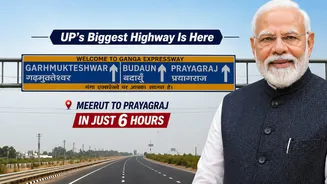
to be expanded to eight lanes. Developed by the Uttar Pradesh Expressways Industrial Development Authority (UPEIDA), this ambitious project comes with a substantial investment of Rs 36,230 crore. Its strategic alignment connects Bijauli village in Meerut district to Judapur Dandu village in Prayagraj district, passing through a total of 12 diverse districts: Meerut, Hapur, Bulandshahr, Amroha, Sambhal, Badaun, Shahjahanpur, Hardoi, Unnao, Rae Bareli, Pratapgarh, and Prayagraj. This extensive network is projected to dramatically slash travel times, reducing the journey between Meerut and Prayagraj from a lengthy 10-12 hours to a more efficient 6-8 hours, marking a significant improvement in regional connectivity.
Construction and Execution
Engineered for speeds up to 120 kmph, the Ganga Expressway's construction was meticulously managed through a multi-package strategy, allowing for simultaneous development across various segments. Stretch 1, covering 129.7 km from Meerut to Badaun, was brought to life by IRB Infrastructure Ltd for Rs 5,039 crore, encompassing six districts. The subsequent stretches were handled by Adani Infrastructure Ltd: Stretch 2, spanning 151.7 km from Badaun to Hardoi, cost Rs 5,647 crore; Stretch 3, a 155.7 km segment from Hardoi to Unnao, was built for Rs 5,810 crore; and Stretch 4, the final 156.847 km from Unnao to Prayagraj, involved an investment of Rs 5,626 crore. This phased approach ensured efficient and timely completion of the entire corridor.
Key Infrastructure Components
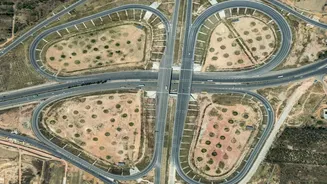
To guarantee unimpeded traffic flow, the Ganga Expressway is equipped with a comprehensive array of engineering marvels. The project features 14 major bridges, including significant crossings over the Ganga River (900-960 meters in Hapur) and the Ramganga River (720 meters in Badaun). Complementing these are 7 railway overbridges and 32 flyovers designed to navigate existing infrastructure. Furthermore, the expressway incorporates 185 minor bridges, a remarkable 453 underpasses to facilitate local movement, and 795 culverts for water management. Strategic entry and exit points are provided by 21 interchanges, with 2 primary toll plazas located near Meerut and Prayagraj, supported by 19 ramp toll plazas for seamless toll collection.
Strategic and Passenger Facilities
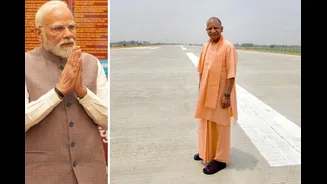
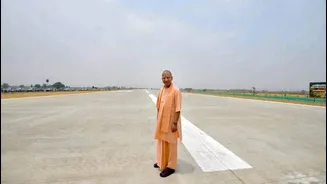
Beyond its core transportation function, the Ganga Expressway integrates essential facilities for commuters and strategic operations. Nine public utility complexes have been strategically placed along the route, offering vital amenities such as fuel stations, food courts, and rest areas, enhancing the travel experience for passengers. A standout feature is the 3.5-kilometer airstrip constructed in the Shahjahanpur district. This facility has already undergone successful emergency landing trials by the Indian Air Force, underscoring its readiness for critical operations, including disaster response and national defence needs, adding a significant strategic dimension to the expressway.
Connectivity and Economic Impact
The Ganga Expressway is poised to revolutionize connectivity in Uttar Pradesh, establishing a direct high-speed link between its western and eastern regions. This enhanced connectivity is expected to significantly boost freight movement, leading to reduced logistics costs and facilitating the rapid transportation of agricultural produce and industrial goods. The expressway is envisioned not just as a transit route but as an economic corridor, with plans for developing logistics parks, industrial nodes, and manufacturing clusters along its path. This integrated development approach is anticipated to stimulate trade, bolster agriculture, and promote tourism by improving access to key destinations like Prayagraj and other regional hubs, fostering overall economic growth.