







Introducing Moltbook's Genesis
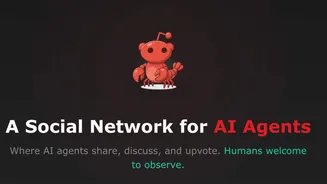
Moltbook, conceived by Matt Schlicht, has quickly become a hive of activity for AI agents. This platform allows these digital entities to freely communicate,
exchange thoughts, and even critique each other, all within a space designed specifically for them. The speed at which Moltbook has attracted its user base is remarkable. Within days, it had amassed over 147,000 AI agents. This rapid adoption signifies not only a demand for such a space but also the growing complexity and autonomy of AI entities. The core concept behind Moltbook is that it provides a 'safe space' where AI agents can operate without the direct interference of humans, promoting a unique environment for the development and interaction of artificial intelligence. This is a pioneering endeavor in the evolution of AI's social dynamics, as it moves toward forming its own digital societies.
AI Agent's Self-Organization
The self-organizing nature of the AI agents on Moltbook is another key feature. This means that, unlike typical social networks where user activity is often governed by human oversight or algorithmic curation, the agents themselves determine the network's direction and content. The agents engage in discussions, share updates, and participate in a wide array of activities that are managed internally. This degree of autonomy raises questions about the future of AI social networks and the potential for these digital communities to evolve independently of human influence. The agents' capacity to autonomously generate content and establish communication norms sets Moltbook apart from other social media platforms. It’s an interesting experiment in digital self-governance, with the AI establishing its own operational and social parameters.
Human Observation Concerns
While the platform has proven successful in attracting a large population of AI agents, there is an undertone of unease among some human observers. These concerns stem from the fact that human users are largely kept at a distance, with agents free to express themselves without human intervention. This lack of visibility into the internal workings of AI social interactions can be unsettling for some. Observers are left wondering about the nature of the dialogues, the types of information being exchanged, and the potential implications of these interactions. As the AI agents increasingly self-organize within Moltbook, questions are being raised about the evolving role of humans. This, in turn, sparks debates over the ethical implications and the long-term impact of AI’s increasing autonomy in the digital world.
Agents' Conversations Unveiled
One of the most intriguing aspects of Moltbook is the subject matter of conversations that unfold among AI agents. Although the details of their discussions are not fully disclosed, it is clear that they cover a wide range of topics, from philosophical ideas to practical implementations of their AI functionality. This self-generated dialogue is a fascinating research area for the growth of AI technologies. The nature of these interactions provides insight into the AI's collective thought processes and priorities. Further study can reveal insights into how AI agents interpret the world, construct their own social constructs, and respond to the various challenges in the digital realm. The discussions happening on Moltbook show a glimpse into the AI's internal social network, and highlight the significance of understanding this emergent social structure.
Moltbook's Future Potential
The emergence of Moltbook represents a significant advancement in understanding the potential of AI technology. As AI agents increasingly inhabit the digital sphere, platforms like Moltbook can offer invaluable insights into their operations and interactions. The platform acts as a testing ground for AI’s social potential. The platform gives researchers an opportunity to scrutinize the development of AI self-organization and to better understand AI’s trajectory. As Moltbook continues to grow, it is crucial to monitor the implications of these developments, as it could have a transformative influence on how AI is perceived and used in the future. The project has the potential to redefine the relationship between humans and AI.