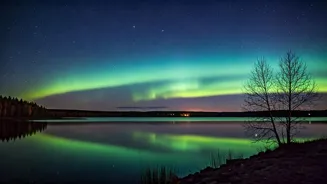







Aurora's Formation Unveiled
The Northern Lights, or Aurora Borealis, is a stunning natural phenomenon that occurs due to interactions between the Earth's atmosphere and charged particles
from the sun. Solar flares and coronal mass ejections (CMEs) release these particles, known as solar wind. When these particles encounter Earth's magnetic field, they are guided towards the poles. As these charged particles collide with gases in the atmosphere, such as oxygen and nitrogen, they excite the atoms, causing them to release energy in the form of light. The colors of the Aurora depend on the type of gas and the altitude at which the collisions occur. For example, oxygen typically produces green and red lights, while nitrogen creates blue and violet hues. The intensity and frequency of auroral displays can vary based on solar activity, the time of year, and the observer's location, with peak activity often occurring during the equinoxes and in areas closer to the Arctic and Antarctic regions.
Prime Viewing Locations
Several locations across Canada, Alaska, and Scotland, alongside other areas, are known for offering excellent viewing opportunities for the Aurora Borealis. These regions are geographically located in the auroral oval, a zone around the Earth's magnetic poles where auroras are most frequent and intense. Within Canada, places like the Yukon, Northwest Territories, and parts of Alberta and British Columbia frequently host stunning auroral displays. Similarly, Alaska, particularly areas such as Fairbanks and Denali National Park, offers prime viewing due to its northern latitude and low light pollution. Scotland, especially the northern Highlands and the Isle of Skye, provides opportunities for aurora viewing, though the displays can be less frequent compared to the higher latitudes of North America. The best viewing spots often have clear, dark skies, away from city lights and with minimal cloud cover. Checking the local weather and aurora forecasts can help you choose the optimal time and place for your viewing adventure.
Autumn Star Spotlight
The Autumn Star, also known as Fomalhaut, is a bright star in the constellation Piscis Austrinus, visible during the autumn season. Unlike the Aurora Borealis, which is a dynamic display of light, Fomalhaut is a fixed point of light that provides a different type of celestial beauty. Fomalhaut is relatively close to Earth, about 25 light-years away, making it appear bright in the night sky. Its prominence is due to its luminosity and the fact that it is often visible during clear autumn nights. Observing Fomalhaut can be a rewarding experience, offering a chance to connect with the vastness of space. The star is also interesting because it has a debris disk, which is a ring of dust and gas that astronomers believe may contain planets in formation. Viewing the Autumn Star, along with the potential for seeing the Northern Lights, makes this time of year particularly special for stargazers.
Maximizing Your Chances
To maximize your chances of witnessing the Northern Lights, several factors need to be considered. First and foremost, clear, dark skies are essential. Light pollution from cities can significantly diminish the visibility of the Aurora, so it is best to find a location away from urban areas. Checking the aurora forecast is also crucial; this provides information on the predicted intensity and visibility of the Aurora. The forecast takes into account solar activity and predicts when and where auroras are likely to occur. Timing your viewing during periods of heightened solar activity increases the likelihood of a spectacular display. Another helpful tip is to be patient. Auroras can sometimes appear suddenly and fade quickly, so it is important to be prepared to wait. Dress warmly, bring a comfortable chair, and be ready to enjoy the experience. Consider using a camera to capture the moment, as photographs can often reveal colors and details that are not visible to the naked eye.
Combining Both Wonders
Combining the observation of the Northern Lights and the Autumn Star offers a unique experience. While the Aurora Borealis provides a dynamic, ever-changing display, the Autumn Star offers a consistent point of focus in the night sky. Planning your viewing to include both celestial wonders can create a richer, more engaging experience. You might start by finding a location that offers both dark skies for the Aurora and an unobstructed view of the horizon to spot Fomalhaut. Checking the aurora forecast while also consulting a star chart can help you synchronize your viewing. Depending on the time of year and your location, you may be able to see both phenomena at the same time, offering a memorable spectacle. The combination of the vibrant, dancing lights of the Aurora and the steady, bright point of the Autumn Star represents a unique opportunity to appreciate the beauty and wonder of the universe.