






Parisian Elegance and Future Visions
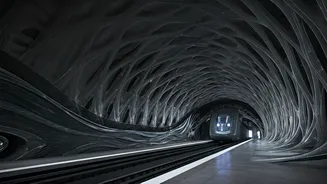
The Parisian Metro system showcases a fascinating duality, from futuristic designs to historical preservation. Villejuif-Gustave Roussy, a recent addition,
impresses with its intricate glass and steel structure, illuminated by a massive central shaft, a testament to modern architectural ambition. In contrast, stations like Bastille preserve remnants of history, such as sections of the original Bastille prison walls, offering a tangible link to the past. The Arts et Métiers station, with its brushed copper platforms, artfully evokes Jules Verne's submersible tales, demonstrating Paris's consistent ability to infuse its transit system with art and narrative. This blend of innovation and historical reverence defines the city's approach to its underground network.
Moscow's Underground Palaces
Moscow's metro stations are legendary for their opulent design, often referred to as 'underground palaces.' Komsomolskaya station, opened in 1952, exemplifies this grandeur with its elaborate ceiling mosaics depicting Russian military triumphs and WWII scenes, alongside ornate pillars and sparkling chandeliers. Novoslobodskaya, also inaugurated in 1952, is celebrated for its 'underground palace' aesthetic, distinguished by its striking stained-glass panels, backlit to create a luminous effect, all framed by polished brass. These stations are not merely functional transit points but are treated as monumental spaces, reflecting a past era's emphasis on public art and civic pride, making them destinations in their own right.
Artistic Expressions Worldwide
Across the globe, metro stations serve as canvases for artistic and architectural expression. Xiamen, China's Wuyuanwan station, revamped in 2024, features a striking façade of red concrete panels, inspired by traditional Minnan architecture and incorporating contemporary sculptures by Su Wu. In Stockholm, Kungsträdgården station uniquely preserves elements of demolished heritage homes, integrating historical artifacts like fountains and carved columns into its 1977 design. Meanwhile, Naples' Monte Sant’Angelo station, a creation of Anish Kapoor, uses weathered steel and draws inspiration from Dante's Inferno and local volcanoes, demonstrating how diverse cultural and natural influences can shape urban transit architecture.
Global Transit Masterpieces
The world's metro systems are increasingly recognized as architectural marvels that go beyond simple transportation. While many stations globally offer unique aesthetic experiences, some stand out for their specific contributions. Stockholm's metro is famously dubbed the 'world's longest art gallery,' with over 90 stations showcasing the work of more than 150 artists. Dubai's metro stations present a futuristic vision with their distinctive 'eye'-shaped designs and advanced technology. Each of these, along with others like the Brutalist Washington Metro or the historically rich Kolkata Metro, transforms the daily commute into an encounter with art, history, and innovation, underscoring the evolving role of urban transit infrastructure.