





A Clever Design
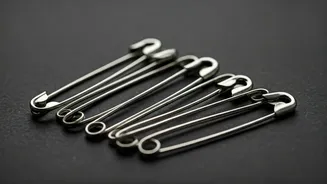
The safety pin’s seemingly straightforward form belies its intricate construction. Essentially, the design pivots around two critical components that work
seamlessly. The coiled wire functions as a spring, which is the heart of its secure fastening. The tension created by this spring is pivotal to hold the sharp tip in its closed position. Without this carefully engineered pressure, the pin would open freely, posing a risk of injury. In essence, the design transforms a potential hazard into a safe and reliable tool. This thoughtful combination is what makes the safety pin so effective, highlighting how simplicity can be combined with ingenuity to create an everyday item.
Ancient Origins
The history of the safety pin dates back centuries, with its roots traceable to the Bronze Age in Europe. Known as the fibulae in ancient Latin, early versions were created in various designs. It's fascinating to note how the concept of secure fastening has evolved. Pins in different traditions varied. In Central European, Greek, and Italian cultures, single-wire pins were common, featuring a central spring and a sharp end. The other end would be bent to secure the tip. While there was also the Northern European approach, which used two separate parts and lacked a spring, with one pin featuring a hole for the other to pass through.
Hunt's Invention
The modern safety pin as we know it today is credited to Walter Hunt, who patented his invention in 1849. Hunt's ingenious design involved bending a single piece of wire to form a spring-loaded mechanism. This spring allowed for the sharp point to be securely held, creating the safety aspect. Hunt’s invention revolutionized the way people fastened clothes and other items, leading to the widespread use of safety pins across cultures and industries. Hunt’s innovation was not just a design improvement; it was a clever solution that improved the function while mitigating risks.