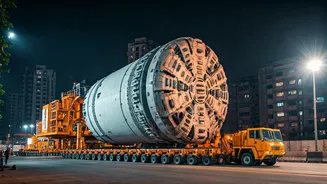







Colossal Machines Begin Journey
In the quiet hours of the night, a significant logistical ballet unfolds across Mumbai's thoroughfares. Convoy after convoy of multi-axle trailers, meticulously
guided by escort vehicles, have been inching their way through the city. These immense trailers are transporting crucial components of two colossal tunnel boring machines (TBMs), destined for the groundbreaking Mumbai-Ahmedabad High-Speed Rail Corridor. The journey, covering distances of approximately 62 kilometers to Vikhroli and 51 kilometers to Savali, is a testament to the complex planning required for such a monumental project. The TBMs, originating from Germany and arriving via China, collectively weigh a staggering 6,000 tonnes and represent a significant investment, with each machine estimated at a cost of around Rs 250 crore. This nighttime operation, restricted to between 11 pm and 5 am, ensures minimal disruption to daily city life while facilitating the movement of these engineering marvels.
Precision Engineering on Wheels
The transportation of these two tunnel boring machines is a feat of engineering in itself, demanding specialized equipment and an intricate route. Each TBM is a behemoth, comprising numerous heavy components. The largest of these, a 300-tonne main drive powering the cutter head, is carried on a massive 144-tyre trailer, pulled by a robust 500-horsepower Volvo truck. In total, a staggering 219 trailers have been mobilized for this operation, moving the machines from Jawaharlal Nehru Port (JNPT) to their assembly sites in Vikhroli and Savali. While the largest components necessitate multiple nights to cover short distances, with a maximum of 10 km per night for the multi-axle trailers, smaller parts arrive more swiftly. The sheer scale is highlighted by the fact that the TBMs, once assembled, will stretch 96 meters in length and boast a diameter of 13.6 meters – nearly equivalent to a four-story building, dwarfing the typical 6.6-meter diameter TBMs used in projects like the Delhi Metro.
Navigating Urban Obstacles
The path from the port to the TBM assembly sites in Vikhroli and Savali was not straightforward and required extensive pre-planning and surveys. The implementing agency, National High Speed Rail Corporation Limited (NHSRCL), commissioned detailed route mapping that identified all potential impediments, including bridges, underpasses, toll plazas, and even the height of streetlights. This meticulous survey led to the selection of a longer, less disruptive route, deliberately avoiding major arterial roads like the Mumbai Trans Harbour Link and the Eastern Express Highway to prevent daytime traffic chaos. Challenges encountered during these surveys were significant; for instance, stone barricades had to be cleared from the JNPT road, and the Kalundri River Bridge required a route diversion due to the immense weight of the consignment. The Khandeshwar railway overbridge underwent a thorough structural analysis before heavy-axle movement was permitted. Even seemingly minor obstacles, like a narrowed road to 7.2 meters on Kalamboli Link Road and a low-hanging overhead cable at Kalamboli Circle, necessitated specific interventions, such as lifting the cable with a T-crane during trailer movement, underscoring the complexity of this operation.
The Human Element and Safety
Behind the colossal machinery and intricate planning are the skilled individuals navigating these complex operations. Mohan Singh, a driver from Ballia, recounts his experience transporting an equally heavy turbine in 2017, a journey that took ten months. He emphasizes the highly complex nature of moving such massive equipment, requiring a team of at least ten people to ensure smooth progress and highlighting the severe consequences of even minor errors. The TBMs are critical for the 21-km underground tunnel stretch of the bullet train project, which passes beneath numerous residential areas. With approximately 600 buildings along the alignment and a challenging 7-km undersea tunnel section, traditional blasting methods (NATM) are deemed too risky due to the potential for surface disruption and structural damage. The precision offered by TBMs is paramount, especially in areas with minimal overburden, such as an 18-storey building where the gap between its foundation and the tunnel is just 5 meters. TBMs enable continuous excavation with minimal surface impact, allowing normal city life to continue above while tunneling progresses below.
Technological Advancements and Scale
The arrival of these tunnel boring machines heralds a significant technological advancement for India's tunneling capabilities. For the first time in the country, a semi-automatic TBM will be deployed, capable of simultaneous drilling and segment deployment. This contrasts with existing TBM projects where these tasks are performed sequentially. The 508-km bullet train project includes a substantial tunnel component, totaling 27.4 km, with 21 km underground. While approximately 5 km of this underground section has already been excavated using NATM, the TBMs will be responsible for the remainder. This transition is expected to dramatically increase excavation rates; NATM yields about 2.5 meters per day, whereas TBMs are projected to achieve 16-20 meters daily. The operational demands of these machines are immense, requiring approximately 10 MW of electricity daily, necessitating the installation of new transmission lines. They also require a substantial 23 lakh liters of water per day, which will be sourced partly from rainwater collected and treated at a plant in Vikhroli. At the Vikhroli site, a 1,700-tonne crane stands ready to assist in the assembly of the TBMs within a prepared excavation shaft measuring 56x56x40 meters.