




A Ground of History
For decades, the expansive Brigade Parade Ground in Kolkata has served as the ultimate barometer of political might in West Bengal. This legendary Maidan,
owned by the Indian Army, has been the stage for pivotal moments in the state's political narrative since the 1950s. It has welcomed international figures and hosted significant national events. In 1955, Soviet leaders Nikita Khrushchev and Nikolai Bulganin were greeted by vast throngs of people. Later, in 2005, Venezuelan President Hugo Chavez delivered a speech at a Left Front gathering. The ground also marked national milestones, such as the post-Bangladesh liberation celebration where Prime Minister Indira Gandhi and Bangabandhu Sheikh Mujibur Rahman appeared together. It has been a platform for opposition unity, notably hosting an anti-Congress conference in 1984 with prominent leaders like Jyoti Basu and N.T. Rama Rao, and more recently, Mamata Banerjee's opposition meet in 2019, showcasing its continuous role in shaping political discourse.
Ideological Metamorphosis
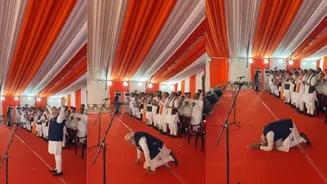
The Brigade Parade Ground, once the undisputed stronghold of the Left Front, where countless red flags signified their 34 years of continuous rule, was dramatically draped in saffron hues. Political analysts interpret this significant visual shift as the BJP's deliberate strategy to broadcast that the state's political 'center of gravity' has irrevocably moved. This momentum toward such a transformation had been building earlier in the year. Prime Minister Narendra Modi initiated his "Paribartan Yatra" from this very same Brigade Ground on March 14, an event where he emphatically declared that political change in Bengal was not just possible, but inevitable. The symbolic adoption of this historic venue by the BJP underscores their intent to redefine Bengal's political identity and assert their growing influence.
Saffron Tide Arrives
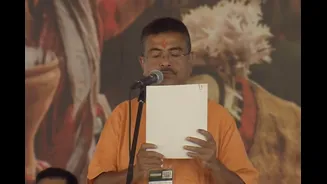
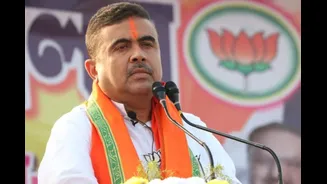
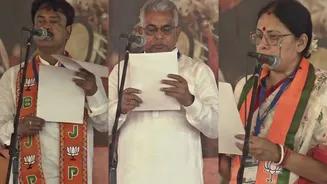
The sheer scale of the event held on Saturday was a clear reflection of the BJP's ambition to bring their campaign slogan to life. Approximately one lakh people congregated at the venue, with elaborate rain shelters installed to accommodate 50,000 supporters, shielding them from any potential monsoon downpours. A distinguished VIP section was meticulously arranged, accommodating foreign diplomats, prominent business leaders, esteemed justices, and Bollywood celebrities, alongside the newly elected Members of Parliament. The cultural tapestry of the Maidan was enriched with terracotta-inspired designs and artistic installations drawing from the iconic Dakshineswar temple and the unique Sunderbans region. The vibrant performances of Chhau, Baul, and Gambhira dances further added a profound cultural dimension to the grand occasion. Ensuring the safety and order of this massive gathering, a robust security network comprising around 4,000 police personnel was deployed, with the venue meticulously divided into multiple security grids.
Legitimizing Power on Maidan
In the political landscape of West Bengal, while elections are the formal mechanism for determining which party assumes governance, the Brigade Parade Ground has historically functioned as the crucial arena for legitimizing that power. The BJP's decision to take their oath of allegiance amidst a sea of their enthusiastic supporters marks yet another significant chapter in the storied history of the Maidan. This expansive ground has consistently served as the definitive space where every dominant political force has sought to solidify its mandate and establish its historical claim to leadership, making it an enduring symbol of political validation and transition.