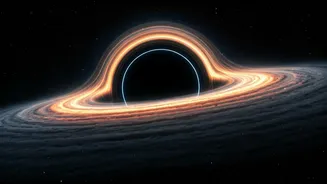








Why Black Holes?
Black holes, often portrayed as celestial vacuums, are pivotal cosmic entities whose significance extends far beyond their immense gravity. They are fundamental
in shaping galaxies and influencing the evolution of the universe. Supermassive black holes reside at the core of most galaxies, and their gravitational influence governs the motion of stars and gas clouds surrounding them. Furthermore, black holes serve as extreme laboratories for testing the fundamental laws of physics, specifically Einstein's theory of general relativity. The study of black holes enhances our understanding of the universe's structure, dynamics, and the behavior of matter under extreme conditions. Moreover, observing the mergers of black holes provides valuable data about gravitational waves, ripples in spacetime, giving insights into the most violent events in the cosmos and aiding in the validation of cosmological models.
Supermassive Black Holes
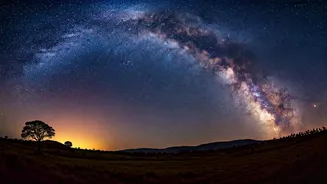
At the heart of nearly every galaxy, including our own Milky Way, lies a supermassive black hole (SMBH). These colossal entities possess masses millions or even billions of times greater than the Sun. They play a critical role in galactic formation and evolution, impacting their host galaxy's structure and activity. The SMBH at the center of the Milky Way, Sagittarius A*, has a mass of about 4 million times that of the Sun. Scientists study the behavior of stars near SMBHs to understand their effects, observing stars orbiting at incredible speeds. The intense gravity of these black holes can also trigger the creation of powerful jets of energy and matter, influencing the surrounding galactic environment. Furthermore, SMBHs are believed to have a significant role in regulating star formation and galaxy growth, making them central to understanding the cosmos.
Stellar Black Holes
Stellar-mass black holes originate from the collapse of massive stars at the end of their lives. When a star exhausts its nuclear fuel, it can no longer sustain the outward pressure needed to counteract the inward force of gravity. If the star is massive enough, it undergoes a supernova explosion, and the core implodes, forming a black hole. These black holes typically have masses ranging from a few times to dozens of times that of the Sun. They often exist in binary systems with other stars, where they can draw material from their companion stars, forming an accretion disk that emits intense radiation. Detecting stellar-mass black holes involves observing this radiation or studying the motion of stars influenced by their gravity. Such observations help in mapping their distribution and studying the phenomena associated with matter falling into these cosmic entities, aiding in the investigation of gravity and the behavior of matter under extreme conditions.
Intermediate & Primordial
Intermediate-mass black holes (IMBHs) are another class of black holes with masses between those of stellar and supermassive black holes, typically ranging from 100 to 100,000 times the mass of the Sun. While they are predicted to exist, their discovery is still ongoing. They are believed to reside in the cores of dwarf galaxies and globular clusters, indicating their potential role in galactic evolution. Primordial black holes, in contrast, are hypothesized to have formed in the early universe, possibly from density fluctuations during the Big Bang. Their masses could vary, potentially including some with extremely small masses. The existence of IMBHs and primordial black holes has implications for understanding galaxy formation and the nature of dark matter. Finding and studying them could offer essential insights into cosmology and the universe’s earliest moments. Therefore, the search for these black holes and their study are vital areas of astronomical research.
Black Hole Dangers
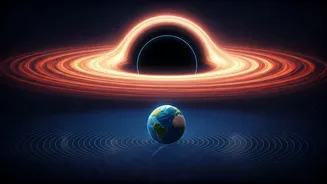
While black holes possess extreme gravitational forces, it's a common misconception that they are cosmic vacuum cleaners that devour everything in the universe. The key lies in understanding the immense distance required to encounter a black hole's event horizon. At a significant distance, their gravitational effects are similar to any other object of equivalent mass. The area around a black hole that nothing, not even light, can escape is known as the event horizon. Should an object cross this boundary, it would be pulled into the black hole and would eventually be stretched and torn apart through a process known as spaghettification. Nonetheless, the likelihood of such an event is incredibly small due to the vast distances between black holes and other celestial bodies. In binary systems, where black holes and companion stars interact, the material pulled away from the star forms an accretion disk, emitting strong radiation. However, the black hole itself remains a distant, extreme astrophysical object.