







Advanced Food Lab Inaugurated
Tirumala is ushering in a new era of food quality control with the establishment of a state-of-the-art food testing laboratory. Spearheaded by the Andhra
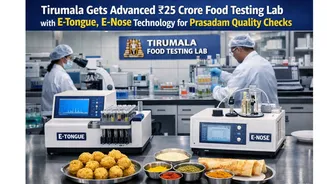
Pradesh government, this facility is dedicated to ensuring that the prasadam offered to devotees adheres to the most stringent safety and quality benchmarks. The project, developed through a collaboration between the state government and the Food Safety and Standards Authority of India (FSSAI), signifies a significant investment of approximately Rs 25 crore. The facility, housed in a renovated 12,000-square-foot former flour mill, is poised to commence operations imminently, with a dedicated team of around 40 personnel from both the Tirumala Tirupati Devasthanams (TTD) health department and the state health department managing its functions. This comprehensive upgrade is designed to bolster confidence in the sacred offerings and maintain the sanctity of the devotional experience.
The 'E-Nose' & 'E-Tongue' Explained
The centerpiece of this advanced laboratory will be two sophisticated imported machines: an 'electronic nose' and an 'electronic tongue,' reportedly costing Rs 3.5 crore. The 'electronic nose' is engineered to meticulously detect subtle variations in aroma, capable of identifying even minute discrepancies that might indicate a deviation from expected standards. Complementing this, the 'electronic tongue' is designed to analyze taste and purity, discerning slight alterations in flavor profiles and textures that may elude human senses. These remarkable devices are particularly vital for scrutinizing the quality of ghee, a fundamental ingredient in the renowned Tirumala laddu, by detecting even the most imperceptible changes in its purity, taste, aroma, and texture. Their deployment marks a significant technological leap in ensuring the integrity of sacred food offerings.
Comprehensive Testing Capabilities
Beyond the groundbreaking 'electronic nose' and 'electronic tongue,' the new laboratory is equipped with a suite of other advanced analytical instruments. This includes an array of sensors designed to assess the freshness of raw materials, alongside specialized microbiology testing equipment to detect potential contaminants. Further bolstering its capabilities, the lab will house machinery capable of identifying the presence of metal contamination and pesticide residues, ensuring a holistic approach to food safety. The laboratory's scope extends to testing over 60 different types of raw materials integral to prasadam preparation. This extensive list encompasses essential items such as ghee, cashew nuts, cardamom, sugar, almonds, cumin seeds, water, various dry fruits, rice, raisins, and chickpeas, covering every facet of the ingredient supply chain.
Global Precedent & Motivation
The adoption of electronic nose and tongue systems is not novel within the global food industry; these technologies are widely employed across numerous countries for a diverse range of food and beverage analyses. Their application spans the quality control of milk products, edible oils, spices, tea, coffee, and even pre-packaged foods, serving as crucial tools in research centers and food safety departments. The decision to integrate this advanced technology into Tirumala's operations is significantly influenced by recent serious allegations concerning the use of adulterated ghee in laddu preparation. Specifically, findings from a Special Investigation Team (SIT) in November 2025 revealed that a company from Uttarakhand had supplied an estimated 60 lakh kg of allegedly adulterated ghee to TTD between 2019 and 2024, valued at approximately Rs 240 crore. The SIT's report detailed that this ghee was purportedly mixed with palm oil, palm kernel oil, palmolein, beta-carotene, and other adulterants, manipulated to meet laboratory test parameters and maintain a deceptive aroma, underscoring the critical need for the enhanced oversight provided by the new lab.