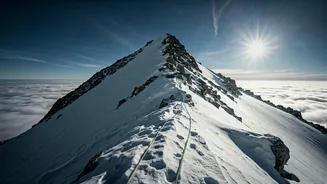








The Treacherous Altitude
Mount Everest, revered globally and known by names like Sagarmatha and Chomolungma, stands as the world's highest peak at a staggering 29,035 feet. While
its majestic stature draws adventurers, a perilous secret lurks on its upper reaches: the 'death zone.' This critical altitude, typically commencing around 8,000 meters, presents an environment so rarefied that human life is unsustainable. The thin air deprives the body of essential oxygen, leading to hypoxia, a dangerous condition where tissues suffer from oxygen deprivation. This can manifest in a cascade of severe ailments, from disorienting nausea and crippling headaches to high-altitude cerebral edema, a condition where fluid seeps into brain tissue, impairing cognitive functions and potentially leading to loss of consciousness. Furthermore, the sheer exertion required to ascend Everest often depletes climbers' energy reserves, leaving them vulnerable to exhaustion and unable to descend, compounding the risks inherent in this hostile terrain.
Physiological Dangers Unveiled
Beyond the immediate threat of hypoxia, the 'death zone' on Mount Everest unleashes a barrage of physiological assaults. Climbers face the risk of high-altitude pulmonary edema, a life-threatening condition where blood vessels in the lungs constrict, impeding the air sacs' ability to absorb oxygen. Symptoms include a persistent cough, extreme shortness of breath even at rest, and a disconcerting discoloration of the skin. Without timely descent to lower altitudes, this condition can prove fatal. The heart is also put under immense strain, working overtime to circulate blood through the body, contributing to profound physical fatigue. The cumulative effect of these extreme conditions can lead to organ damage, underscoring the brutal nature of Everest's upper reaches. The combination of frigid temperatures, violent winds, and unpredictable snowstorms exacerbates these internal struggles, making every step a battle for survival.
The '2 O'Clock Rule' and Preservation
To mitigate the escalating dangers, mountaineers adhere to a crucial '2 o'clock rule.' This unwritten law dictates that if climbers haven't reached the summit by 2 PM, they must turn back, regardless of their proximity to the top. This strict time limit is in place because the ascent from Camp IV (at approximately 7,950 meters) to the summit can take anywhere from seven to nine hours, and any delay risks depleting vital supplies. A more chilling consequence of the 'death zone's' extreme conditions is the lack of decomposition. Bodies of climbers who perish on the mountain are typically left behind, as the risks associated with retrieving them are too great for their companions. The minimal oxygen and frigid temperatures create an environment where decomposition occurs at an infinitesimally slow rate, meaning these bodies can remain preserved in the snow for extended periods, a somber testament to the mountain's unforgiving nature.
Preparation and Vulnerabilities
Ascending Mount Everest is not merely a physical feat; it is an undertaking of immense financial and personal commitment. Expedition permits alone can range from $40,000 to over $100,000 for a seven-person team. Certain individuals are at heightened risk and must exercise extreme caution or avoid such expeditions altogether. Those with pre-existing heart and lung conditions, high blood pressure, sickle cell disease, or sleep disorders like sleep apnea are particularly vulnerable to the adverse effects of high altitudes. The challenges posed by the 'death zone,' even decades after the historic first ascent by Edmund Hillary and Tenzing Norgay, highlight the enduring dangers of Everest. Building robust physical strength and meticulously preparing the body are paramount for any climber attempting to conquer this formidable peak.