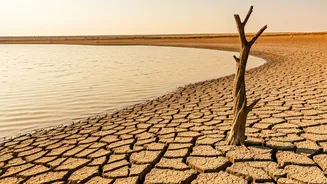







Lake Capacity Concerns
Mumbai, a city reliant on a network of seven reservoirs for its daily water needs, is facing a growing predicament as summer temperatures climb. These
crucial lakes – Vihar, Tulsi, Tansa, Bhatsa, Middle Vaitarna, Upper Vaitarna, and Modak Sagar – are experiencing a significant reduction in their water holding capacity due to the accumulation of silt. This ongoing issue, highlighted by municipal corporators, poses a direct threat to the city's water security, particularly during the arid summer months when demand is highest and natural replenishment is at its lowest. The problem is compounded by the fact that the city lacks natural freshwater sources and depends entirely on these managed water bodies, making their optimal functioning paramount for the survival of millions.
Root Causes of Silt
The excessive silt buildup in Mumbai's water-supplying lakes is attributed to a confluence of environmental pressures, primarily driven by rapid urban development and inadequate waste management practices. Increased urbanization leads to more land being cleared and built upon, disturbing natural soil structures and increasing runoff into water bodies. Deforestation in the surrounding catchment areas further exacerbates this problem, as trees play a vital role in stabilizing soil and preventing erosion. Coupled with this is the issue of uncontrolled garbage disposal, where waste often finds its way into rivers and streams that feed the lakes, contributing to the sediment load. These factors collectively diminish the lakes' natural ability to store water, leading to the current crisis.
Corporators' Demand
In response to the escalating water crisis, a delegation of municipal corporators has formally submitted a notice of motion to the Brihanmumbai Municipal Corporation (BMC). This motion unequivocally calls for a scientific survey of all seven water-supplying lakes to accurately assess their current water levels and the extent of silt contamination. Following this survey, the corporators are advocating for a phased and time-bound program for the removal of accumulated silt. They believe that such a structured approach is essential to restore the lakes' original water holding capacity and to ensure a stable and reliable water supply for Mumbai's residents. The proposal also includes a request for the civic administration to submit a detailed report outlining the proposed desilting strategy and timeline.
Desilting History
The urgency of the current situation is underscored by the fact that Mumbai's seven major water-supplying lakes have not undergone a desilting process since 2015. Desilting is a critical maintenance procedure that involves the removal of granular material, primarily composed of mud and clay sludge, from the bottom of water bodies. This accumulation directly impacts the water storage capacity and can also affect the overall quality of the water. Civic officials have acknowledged that while reports from the Maharashtra Engineering Research Institute (MERI) on Tansa and Middle Vaitarna dams indicated a marginal drop of only 0.2 percent in holding capacity, this does not negate the broader concern of silt accumulation across all lakes. The lack of desilting over the past decade means that the problem has likely worsened considerably.
Current Water Stock
As of April 9, 2026, Mumbai's seven lakes collectively hold approximately 35% of their total capacity, equating to 5.20 lakh liters against a total potential of 14.47 lakh liters. This figure represents a slight improvement compared to previous years; last year on the same date, the stock was at 32.48%, and in 2024, it stood at 26.98%. Typically, one percent of stored water is sufficient to supply the city for three days. However, civic officials have cautioned that the current high temperatures are accelerating the rate of evaporation, leading to a faster depletion of the available water stock than would be usual. While an early monsoon is anticipated, mitigating the immediate risk of water cuts, sustained high temperatures could still pose a challenge to water availability.