



A Return to Roots
The Himachal Pradesh Assembly Secretariat has made a significant pivot, reverting to time-honored wood-fired cooking techniques to serve meals to its legislators
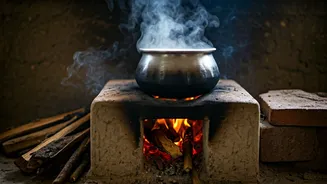
and staff. This unexpected move is a direct response to a critical shortage of LPG cylinders, which has disrupted the normal operations of the Assembly's canteen. Cooks are now diligently using 'char,' essentially embers from burning wood, to prepare dishes, a practice that was once ubiquitous but has largely been supplanted by contemporary kitchen appliances. This decision underscores the considerable challenges the state is encountering in securing basic provisions, even for its highest elected officials. As of now, there is no concrete indication from the Assembly Secretariat regarding the anticipated resumption of standard LPG services, leaving the duration of this traditional approach uncertain.
The 'Char' Setup
Amidst the persistent, heavy rainfall that has cooled Shimla to 11°C, a dedicated team of eight cooks, under the expert guidance of head cook Dhani Ram Sharma, is meticulously preparing firewood. They are arranging it within a substantial cavity, measuring six feet in length and one foot in width, which was excavated two days prior. This makeshift cooking area is situated in a sheltered corner of Hotel Holiday Home (HHH), a well-known property managed by the Himachal Pradesh Tourism Development Corporation (HPTDC), located close to the Old Bus Stand Road. Tulsi Ram, a member of the cooking squad, shared his astonishment, describing the cavity as a 'char' in their local dialect – a traditional stove used for centuries in villages but now seldom seen. He remarked on the irony of an institution like HHH having to embrace these ancestral kitchen practices, deeming it an unprecedented situation.
Traditional Methods for Modern Needs
The Himachal Pradesh Tourism Development Corporation (HPTDC), which not only operates establishments like the Triple-H but also handles catering for official functions, including the state Assembly's ongoing Budget session, has opted for a significant departure from its usual methods. In response to the prevailing LPG scarcity, the corporation has decided to transition from modern cooking apparatus such as high-powered electric and gas stoves to traditional firewood-based cooking. Dhani Ram Sharma, overseeing the 'char' operation, elaborated on his involvement. Having previously served as a 'boti' (a traditional chef specializing in wedding and religious event catering) in his native Rampur, Shimla, he was approached by his superiors. Officials were looking for an experienced individual to manage lunch preparations for approximately 550 people, encompassing MLAs and the Chief Minister, during the Budget session while conserving gas. The traditional 'char' immediately came to his mind as the most viable solution, and it transpired that officials had already leaned towards this method, seeking someone with the requisite expertise.
Efficiency and Fuel Choice
The 'char' was prepared in advance, the day before the Budget session commenced on March 18th. Sharma highlighted the remarkable fuel efficiency of this traditional method, noting that while seven to eight cylinders of LPG are typically consumed within a three-day period during Assembly sessions, the period between March 18th and 20th saw less than one full commercial LPG cylinder being used. Sharma also emphasized the importance of selecting the correct type of firewood for optimal 'char' cooking. He stated that while various woods can be used, 'baan' (scientifically known as Quercus leucotrichophora) is the preferred choice. Although 'chir' (pine) wood is readily available at government depots and is effective for starting and intensifying fires, 'baan' wood is favored because it produces less dense and less irritating smoke, ultimately contributing to a superior taste in the cooked food. The necessary firewood is procured from a nearby Forest Department depot in Kanlog. On March 17th, approximately two quintals of wood were purchased for around Rs 5,500, with further supplies anticipated soon. It's worth noting that LPG cylinders are still employed for reheating certain dishes, such as rajma, shahi paneer, and kadhi-madra, just before they are served at the Assembly.
Laborious Process, Revised Menu
Cooking using the 'char' method is a demanding undertaking, requiring preparations to commence several hours before meal times. Cook Ashwani Kumar explained that this process involves significantly more physical labor compared to using electric or gas stoves. Furthermore, working with the 'char' presents challenges due to the continuous generation of smoke, which, especially during periods of rain, does not dissipate easily within the enclosed space where it has been set up. Kumar contrasted this with their previous routine, stating that when LPG was in use, cooking would typically begin around 10 am, just a few hours before lunch. Now, however, the day starts as early as 7 am. Once the food is cooked at HHH using the 'char,' it is transported to the Assembly, located approximately one kilometer away. This transit occurs about ninety minutes prior to the customary 1 pm lunchtime. Upon arrival at the Assembly kitchen, the food is then reheated on gas stoves before being served to the legislators. HPTDC officials confirmed that the menu had been streamlined with the approval of the House Management Committee.
Legislator Reactions and Future Concerns
Despite the altered culinary approach, some legislators have voiced their approval of the move to cook using the 'char,' remarking that the food possesses a more appealing taste and is perceived as healthier. Dr. Janak Raj, a BJP MLA from Bharmour and a former government physician, cited studies suggesting that food prepared on wood-fired stoves is healthier than that cooked using microwaves, gas, or electric appliances. He observed that the difference in taste was apparent from the very first bite, attributing it to the traditional cooking methods. He also characterized the practice as more environmentally friendly. However, HPTDC director Rajeev Kumar expressed apprehension about the potential escalation of the LPG crisis in the coming months, foreseeing a detrimental impact on tourism, which he identified as the 'backbone of Himachal Pradesh's economy.' He noted that while alternative methods are being adopted, the true test will arrive in May and June, the peak of the summer tourist season. The Assembly session concludes in early April, leaving a significant question mark over the feasibility of transitioning all kitchens in government hotels to traditional stoves on a permanent basis.
Menu Curation and Staff Dedication
Following a review, the menu at HHH, which previously spanned eleven pages, has been condensed to just three pages, with numerous vegetarian and non-vegetarian dishes being removed from the offerings. Despite these adjustments and the inherent challenges, Dhani Ram Sharma and his culinary team remain resolute. Cook Sunil Kumar, also known as 'Chamba,' stated their commitment to ensuring the corporation's continuity and preventing any tourist from leaving their hotels without sustenance. He acknowledged the difficulty of preparing meals for large groups using 'char' and 'chulha' but affirmed their readiness to work tirelessly. Ravinder Sandhu, the Deputy General Manager of HHH, confirmed that meals for significant events like Assembly sessions, parties, and weddings are now prepared using firewood. For less intensive tasks, such as making tea or heating milk, commercial induction systems are utilized. Sandhu also mentioned that the menu has been curtailed, and certain dishes, like Chinese cuisine, are not currently being prepared due to their higher gas consumption requirements.