




Citizenship Shift, Voting Woes
A significant number of people who transitioned to Indian citizenship following the 2015 land swap agreement between India and Bangladesh are now finding
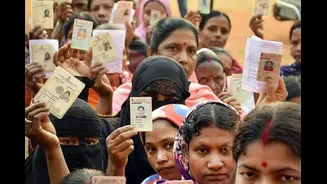
themselves unable to participate in the ongoing West Bengal assembly elections. The Election Commission of India (ECI) has reportedly omitted their names from the voter lists, citing technicalities and inadequate documentation. This exclusion has ignited considerable anger among the affected communities and various political factions, who are levelling accusations of negligence and deliberate suppression of democratic rights against the ECI. These individuals, having once lived stateless, had eagerly anticipated exercising their newly acquired rights as Indian citizens. Their hopes have been profoundly disappointed, leading to feelings of betrayal and marginalization. This situation has become a focal point in the current political discussions, with opposition parties urging for a comprehensive inquiry and swift correction of the electoral rolls. While the ECI has acknowledged the issue and pledged to investigate, the effectiveness and timing of any corrective actions remain uncertain given the elections are already in progress.
The Enclave Exchange Complexities
The disenfranchisement of former enclave dwellers stems from the intricate processes involved in updating citizenship and electoral rolls after the historic exchange of territories between India and Bangladesh. This border agreement, finalized in 2015, involved the transfer of 162 landlocked enclaves. For many residents of these former Bangladeshi enclaves in India, gaining Indian citizenship meant the long-awaited right to vote. However, the transition has not been seamless. For instance, Benimadhab Barman, a 60-year-old from Dakshin Masaldanga in Cooch Behar, experienced this firsthand. His family's names were initially under adjudication, a process of verification. While his wife and children were successfully enrolled, his own name was removed from the voter list. This situation is replicated across many families, where some members are registered while others are not, creating significant distress and uncertainty about their status as eligible voters in the democratic process.
Adjudication and Deletions
The core of the problem for many former enclave dwellers lies in the 'Special Intensive Revision' (SIR) process, which has led to the deletion of names from the electoral rolls, particularly for those whose status was under 'adjudication'. Benimadhab Barman's case exemplifies this: his name was removed despite his family's prior eligibility. He discovered this when trying to update his details online, learning that many others in a similar 'under adjudication' status also faced deletion. Kabiruddin Sheikh from Mashaldanga reported similar issues, with four family members cleared but his sister's name deleted. Osman Gani Sheikh noted that while some family members were cleared after adjudication, others were removed. This selective removal has created confusion and distress. The sheer volume of names under adjudication, with reports of 630 out of 1,191 electors at one polling booth and 200 out of 1,158 at another facing this status, highlights the scale of the issue. Officials state that those removed must appeal to appellate tribunals, a process that is proving challenging for many.
Political Ramifications and Appeals
The disenfranchisement of former enclave dwellers has become a significant political issue in West Bengal, particularly in the Cooch Behar district where these communities are concentrated. Diptiman Sengupta, head of the Bharat Bangladesh Enclave Exchange Coordination Committee, estimates that out of approximately 15,000 former enclave dwellers who were voters in 2015, around 12,800 were eligible. He notes that over 8,000 names were under adjudication, with about 360-370 deleted, while the majority were included. The committee is actively supporting those who have been removed to file appeals. The Bharatiya Janata Party (BJP) candidate from Dinhata, Ajay Roy, has brought up concerns about alleged illegal immigration, suggesting the SIR process might identify and remove such individuals as well. Conversely, the Trinamool Congress (TMC) has strongly criticized the ECI, labelling it an 'agent of the BJP' and accusing it of constitutional impropriety. The TMC leader Partha Bhowmick has highlighted that citizens granted rights in 2015 are now facing adjudication, further fueling political tensions and concerns about fairness in the electoral process.