
Strategic Unification
In a significant move for Elon Musk's business empire, SpaceX, the renowned aerospace company, has officially integrated with xAI, his artificial intelligence
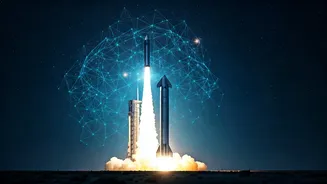
firm. This strategic consolidation brings together the vast capabilities of rocket technology and cutting-edge AI development under a singular corporate structure. The announcement, made public by both entities, signifies a pivotal moment as SpaceX gears up for a potential public offering later this year. The merger is designed to synergize their diverse operations, encompassing space launch systems, advanced AI algorithms, global satellite internet services, and direct-to-device communication technologies. This unified approach aims to streamline innovation and accelerate the realization of ambitious, long-term technological goals by combining hardware prowess with sophisticated software intelligence.
The Space-Based AI Imperative
The driving force behind this groundbreaking merger is the vision to develop and deploy artificial intelligence directly in space. Current AI advancements are heavily reliant on massive, power-hungry data centers located on Earth. These terrestrial facilities consume enormous amounts of electricity and require extensive cooling systems, raising concerns about environmental impact and the sustainability of global energy resources. The statement from the merged entity highlights that the escalating global demand for electricity to power AI cannot be met on Earth without placing undue strain on communities and the environment. Therefore, the long-term solution, according to the companies, lies in harnessing the vastness of space to build data centers and power systems, enabling AI to scale effectively without these terrestrial constraints.
Synergizing Assets and Future Plans
Following the merger, SpaceX will assume oversight of xAI's assets, which notably include the Grok chatbot and the social media platform X. This integration is intended to create what the companies describe as "the most ambitious, vertically integrated innovation engine on (and off) Earth." The combined entity plans to directly link the development of artificial intelligence with the robust infrastructure of space launch systems and expansive satellite networks. This strategic alignment is crucial for the development of space-based AI, allowing for direct application and testing of AI technologies in the unique environment of space. It also positions the company to leverage its existing capabilities in satellite communication to support and distribute AI-driven services globally, further solidifying its role as a leader in both space exploration and artificial intelligence.
Financial Landscape and Investments
This integration occurs within a dynamic financial context for both SpaceX and xAI. SpaceX, as of December, was projected by investors to reach a valuation of approximately $800 billion, bolstered by consistent success in securing satellite launch contracts and government projects. Meanwhile, xAI has also been actively raising substantial capital. Just last month, the company announced a significant $20 billion investment round, valuing it at $230 billion, even amidst some critique of its Grok chatbot. Furthermore, Musk has been progressively intertwining his various ventures; xAI acquired the platform X in early 2025 through an all-share transaction, and Tesla recently declared its intention to invest $2 billion in xAI. These financial maneuvers underscore the significant capital and investor confidence underpinning Musk's ambitious technological roadmap.