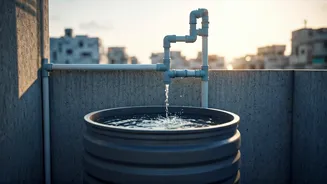







The Mumbai Water Paradox
Mumbai, a city renowned for its heavy monsoon downpours, paradoxically faces annual water shortages. Despite the abundance of rainwater, much of it is
lost to drains and the sea, failing to replenish crucial groundwater reserves. This situation is exacerbated by factors like excessive groundwater extraction, rapid urbanization, and the paving over of open spaces, leading to an unsustainable water future. Citizens often find themselves reliant on water tankers, a costly and inefficient solution. However, one resident, Subhajit Mukherjee, inspired by experts and existing initiatives, decided to engineer a practical answer to this recurring problem, focusing on transforming wasted rainwater into a valuable resource for recharging the earth's water table.
Mukherjee's Harvesting Method
Subhajit Mukherjee's ingenious solution is a do-it-yourself rainwater harvesting system that anyone can implement. The core idea is to capture rainwater from rooftops and channel it directly into the ground to recharge aquifers, rather than letting it flow away. This method is remarkably accessible, with a setup time of approximately three hours and a cost ranging from Rs 2,500 to Rs 5,000, making it a viable option for individual households, housing societies, and educational institutions. Mukherjee's design prioritizes simplicity and affordability, empowering communities to take direct action in addressing water scarcity and promoting sustainable water management practices.
Step-by-Step Implementation
The process begins with excavating a pit, measuring 4x4 feet, positioned about 11 to 12 feet away from any building to prevent potential seepage issues. Within this pit, a recycled container such as a plastic water tank, drum, or barrel of any size is placed. Small perforations are made around this container to facilitate water percolation into the surrounding soil. Next, PVC pipes are used to connect the building's terrace to this container, effectively directing rainwater into it. The final step involves filling the area around the tank with pebbles. These pebbles serve a dual purpose: acting as a natural filter for the incoming water and creating a barrier that ensures cleaner percolation into the groundwater, thus safeguarding the water source.
Beyond Recharging
While the primary function of Mukherjee's system is groundwater recharge, the harvested water can also be put to practical use for daily activities. This reuse significantly reduces reliance on freshwater sources for tasks such as mopping floors, washing vehicles, or general cleaning. Mukherjee emphasizes that even a small saving of five liters per household daily can cumulatively make a substantial difference over time. For those who may not wish to reuse the water directly, the system allows it to naturally seep into the ground, contributing to groundwater replenishment. An alternative design that omits the plastic tank, utilizing only pebbles, is also proposed, further simplifying the process and reducing material dependency.
Spreading the Vision
Subhajit Mukherjee's initiative gained momentum through collaborations with IIT Bombay experts and inspiration from similar efforts championed by Puducherry's Lieutenant Governor, Kiran Bedi. He actively promotes his concept through social media, inviting schools and institutions to adopt this sustainable practice. Mukherjee offers free guidance, emphasizing that his method is a reintroduction of age-old practices, adapted to address modern challenges like groundwater depletion from extensive water boring. His overarching message is one of collective responsibility: 'I'll conserve my water, and I believe everyone should conserve water to consume,' highlighting the significant impact of individual and community-level water conservation efforts.