









What is Kavach?
Kavach, which translates to 'Armor,' is India's proprietary automatic train protection system, meticulously designed by the Research Design and Standards
Organisation (RDSO) in collaboration with Indian Railways. Its primary mission is to drastically reduce train accidents, particularly those stemming from collisions. The system operates with a speed limit of 160 km/hour, ensuring that trains adhere to safe operating parameters. At its core, Kavach is engineered to automatically apply the brakes if a train's loco pilot misses a critical signal or fails to respond within the allotted time, thereby acting as a crucial failsafe in high-speed, high-traffic rail environments. This indigenous innovation represents a significant leap forward in India's commitment to bolstering railway safety across its vast network.
Why India Needs Kavach
India boasts one of the world's most extensive railway networks, characterized by incredibly high traffic density on its primary routes. Historically, train operations have heavily relied on human oversight and conventional signalling systems. This inherent reliance on human control, coupled with environmental factors like dense fog or heavy rainfall that impair visibility, and occasional communication breakdowns, has unfortunately contributed to numerous accidents. Common causes include Signal Passing at Danger (SPAD), human errors by loco pilots, entering wrong track sections, brake failures, and miscommunication. Indian Railways views Kavach as an indispensable safety upgrade, a pivotal step towards achieving its ambitious objective of 'zero accidents' by mitigating the pervasive risk of human error.
How Kavach Works
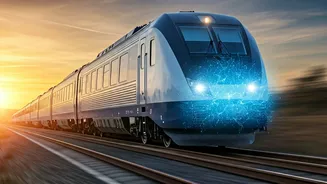
The sophisticated Kavach system functions through a constant, seamless flow of information between trackside equipment, station systems, and the locomotives themselves. It employs a network of sensors, advanced radio communication protocols, and strategically placed trackside devices to meticulously monitor train movements and signal statuses in real-time. Its primary function is to prevent collisions by automatically engaging the brakes if a train is at risk of passing a red signal. Furthermore, it ensures that no two trains occupy the same block section simultaneously, thereby averting potential head-on or rear-end collisions. The system also provides drivers with advance auditory and visual alerts regarding upcoming signals and speed restrictions. Crucially, if the driver fails to react to these warnings within a specified timeframe, Kavach takes autonomous control, initiating braking to slow down or bring the train to a complete halt, thus guaranteeing an added layer of safety.
Kavach Features
Kavach is equipped with a suite of vital features designed to comprehensively enhance train safety. It physically prevents trains from inadvertently crossing red signals, a leading cause of accidents. Signal information is relayed directly to the loco pilot inside the cabin, offering immediate and clear visibility. The system actively monitors train speed, automatically applying brakes if the permissible limit is exceeded. For enhanced safety at crossings, it automatically activates the train's horn. A key function is its ability to prevent collisions between any two trains that are both equipped with the Kavach system. In emergency situations, it can transmit critical alerts to railway control rooms, enabling swift responses. This real-time monitoring capability empowers control rooms with live oversight of train movements across the network.
Global Systems vs Kavach
While global counterparts like Europe's European Train Control System (ETCS) and Japan's Automatic Train Control (ATC) operate on similar principles of automated safety, Kavach is uniquely tailored for the Indian railway landscape. ETCS focuses on cross-border interoperability within Europe, whereas Kavach is a national system specifically designed for Indian Railways' distinct operational environment, which includes mixed traffic on the same tracks and extremely high route density. Unlike ETCS, Kavach is designed to function as an additive safety layer, enhancing existing signalling infrastructure rather than necessitating a complete overhaul. This phased deployment strategy makes it more practical and cost-effective for widespread implementation across India's vast and established network. The design prioritizes affordability, immediate braking control, and seamless integration with India's current signalling systems.
Kavach Deployment
The deployment of the Kavach system is actively progressing across India's railway network, with a strategic focus on high-density corridors and routes identified as accident-prone. Significant installations have been completed on crucial sections of the Delhi–Mumbai and Delhi–Howrah routes, totalling over 1,300 route kilometers commissioned across various railway zones. These include the Tuglakabad–Palwal–Mathura–Nagda stretch, the Vadodara–Virar section, and the Vadodara–Ahmedabad line. Furthermore, installations are underway or planned for sections like Howrah–Bardhaman, Manpur–Sarmatanr, and the New Delhi (ex)–Junction Cabin route. Trials have also been conducted on routes such as Pune–Kolhapur and Daund–Manmad, with ongoing work on Daund–Yeola. Indian Railways is undertaking extensive installation work on over 23,000 route kilometers, encompassing the Golden Quadrilateral, Golden Diagonal, and other High-Density Network routes, solidifying its commitment to comprehensive safety upgrades.