








The Vertical Advantage
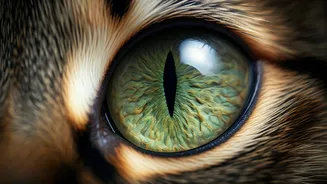
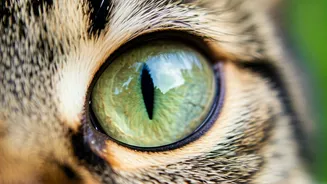
Cats, unlike many other mammals, sport vertical, slit-like pupils that are incredibly effective for their predatory lifestyle. This distinct feature isn't
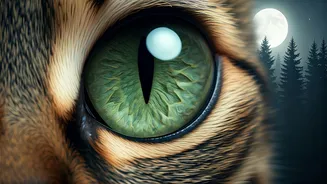
just for show; it's a finely tuned evolutionary tool. Domestic cats are masters of ambush, relying on stealth and sudden bursts of energy to capture their prey. The narrow, vertical slits of their pupils play a crucial role in enhancing their ability to gauge distances with remarkable accuracy, particularly when light conditions are dim. During the day, or in bright environments, these slits can constrict to incredibly fine lines, drastically limiting the amount of light that enters the eye, a far more efficient method than the limiting capabilities of round pupils. Conversely, in low light conditions, such as at dawn or dusk when they are most active, these pupils can dilate into large circles, maximizing light absorption and granting them exceptional night vision. This visual acuity is paramount for their hunting success during twilight hours.
Precision in Pouncing
Beyond managing light intake, the vertical pupils of domestic cats serve another critical function: enhancing depth perception. Researchers have found that these slit-shaped pupils provide a distinct advantage in accurately estimating the distance to their intended targets, especially at close ranges. This precise spatial awareness is absolutely vital for an ambush predator that relies on a perfectly timed pounce. The ability to quickly and accurately process information about their surroundings allows their brains to calculate the exact moment to strike, whether it's a scurrying mouse or a fluttering bird. This heightened sense of depth allows them to bridge the gap between spotting their prey and making the decisive leap with astonishing precision, a skill honed over millennia of evolution for survival.
Big Cats' Different Vision
Interestingly, this slit-pupil characteristic is primarily observed in smaller feline species, such as the common domestic cat or the lynx, and is less common in their larger cousins like lions and tigers. The reason for this divergence lies in their differing hunting strategies and diurnal activity patterns. Larger cats often hunt during daylight hours and may employ pack tactics or rely on sheer power rather than the extreme precision required for a close-quarters ambush. For these big cats, round pupils offer sufficient visual capabilities to suit their environments and hunting methods. While round pupils also adjust to light, the specific advantages of vertical slits for fine-tuned distance judgment at short ranges are less critical for their more open-terrain, often cooperative, hunting endeavors.
Convergent Evolution's Trick
While the slit-like pupils of cats bear a striking resemblance to those of snakes, this similarity is not indicative of a close evolutionary relationship. Instead, it is a prime example of convergent evolution, where unrelated species independently develop analogous traits in response to similar environmental pressures or ecological niches. Both cats and snakes, particularly those that hunt in low-light conditions, have benefited from the superior depth perception and light management offered by vertical pupils. In snakes, this adaptation also aids in camouflage and hunting effectively in dimly lit environments. This shared trait highlights how nature often finds similar solutions to common challenges across diverse lineages, showcasing the adaptability of life itself.