







A Stinky Introduction
The plant kingdom boasts a stunning array of floral scents, ranging from delicate perfumes to overpowering odors. While many flowers are celebrated for
their pleasant fragrances, a select few are notorious for their exceptionally unpleasant smells. These malodorous blossoms employ their pungent aromas to attract specific pollinators, usually insects that are drawn to the scent of decaying matter or carrion. The evolutionary strategy of these flowers involves mimicking the environment where these pollinators typically breed or feed, thus ensuring their survival and reproduction. This article will delve into five such examples, exploring their unique features and ecological significance.
The Corpse Flower (Amorphophallus titanum)
Native to the rainforests of Sumatra, Indonesia, the corpse flower holds the record for producing the largest unbranched inflorescence in the world. When this botanical behemoth blooms, it unleashes a powerful stench that closely resembles the smell of a decaying corpse, hence its descriptive name. This putrid odor, coupled with its dark red color, attracts carrion beetles and flies, which are crucial for pollination. The blooming of the corpse flower is a rare event, often taking several years for the plant to mature enough to flower. These blooms typically last only for about 24 to 36 hours. Its size, rarity, and unique odor make it a significant attraction in botanical gardens worldwide.
Rafflesia arnoldii
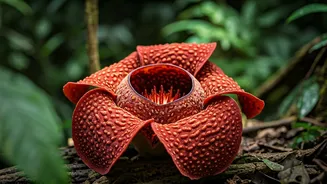
Rafflesia arnoldii, another native of Sumatra and Borneo, is famous for producing the world's largest single flower. Similar to the corpse flower, Rafflesia also emits a foul smell to attract carrion flies. The flower, which can grow up to three feet in diameter, appears as a massive, fleshy, reddish-brown bloom, often with white spots. It is a parasitic plant that grows on the Tetrastigma vine, obtaining nutrients from its host. The flower's brief blooming period and reliance on specific pollinators make it a challenging plant to study and conserve. Rafflesia's existence is a testament to the diversity of life in tropical rainforests and its fascinating adaptations for survival.
The Voodoo Lily (Sauromatum venosum)
The voodoo lily is a plant native to Africa and Asia. This plant is known for its ability to produce a strong stench of rotting meat to attract carrion beetles and flies, its main pollinators. The voodoo lily has a distinctive appearance, with a mottled, snake-like spadix that is surrounded by a spathe. The spathe, often dark purple or brown, serves to enhance the flower's attraction to pollinators. The bloom emits its foul odor for a few days, drawing in the necessary insects to ensure pollination. This plant is a popular choice for gardeners interested in exotic plants due to its unique appearance and intriguing pollination strategy.
Stapelia gigantea
Stapelia gigantea, also known as the carrion flower, is a succulent native to South Africa. It produces large, star-shaped flowers that are characterized by their strong smell of decaying flesh. The flowers typically have a hairy texture and can range in color from yellow to deep red. Like other plants of this type, it attracts carrion flies, which are fooled into believing they are encountering a food source or a place to lay their eggs. These flies inadvertently pollinate the flower as they move from one to another. Stapelia gigantea is well-suited to arid environments. Its interesting appearance and deceptive tactics make it a unique addition to any succulent garden.