





Barringer Crater's Grandeur
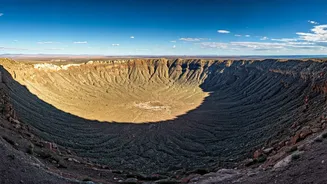
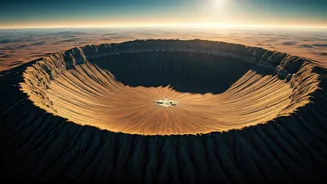
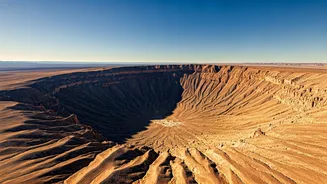
Nestled within the vast Arizona desert, the Barringer Crater stands as a remarkably preserved testament to a cosmic collision that occurred approximately
50,000 years ago. This colossal impact site offers an accessible and awe-inspiring experience for visitors. You can traverse the crater's rim, gaining a true appreciation for its immense scale, while a dedicated visitor center provides fascinating exhibits on space and showcases genuine fragments of meteorites. It's an ideal location for those seeking a close-up, tangible understanding of how these powerful extraterrestrial impacts shape our planet's surface, offering a vivid visual lesson in celestial mechanics and geological forces.
Lonar's Saline Enigma
In the Buldhana district of Maharashtra, India, lies the Lonar Crater Lake, a geological anomaly formed in basaltic rock, a rarity for impact craters. This crater, also approximately 50,000 years old, is distinguished by its unique water chemistry, exhibiting both salty and alkaline properties, which fosters a peculiar and rare ecosystem. The surrounding landscape is further enhanced by the presence of ancient temples and lush greenery, creating a serene atmosphere that complements its scientific intrigue. Lonar Crater Lake offers a captivating blend of natural wonder, ecological uniqueness, and historical resonance, making it a truly distinctive destination for both scientific curiosity and tranquil contemplation.
Vredefort's Ancient Scale
South Africa is home to the Vredefort Crater, recognized as the largest known impact structure on our planet. Having formed over two billion years ago, its original dramatic form has been significantly softened by eons of natural erosion. Despite this, the sheer scale of the impact zone remains immense. Its profound geological significance has earned it a UNESCO World Heritage Site designation. Explorers of this region can witness rock formations that vividly narrate the story of this ancient celestial event, offering a profound connection to Earth's deep geological past and the immense power of cosmic impacts that have shaped its surface over millennia.
Pingualuit's Pristine Form
The Pingualuit Crater in Canada presents a picture of remote and pristine wilderness. Characterized by its exceptionally circular shape, it is a standout geological feature. The lake contained within its depths is renowned for its remarkable clarity and significant depth. Reaching this isolated site requires a dedicated effort, but the breathtaking scenery encountered along the way is a worthy reward. The profound quietude and untouched nature of the location offer a powerful sense of the immense energy unleashed during the original meteor impact, providing a contemplative experience of natural forces.
Wolfe Creek's Clear Shape
Australia's Wolfe Creek Crater is a remarkable example where the impact's distinct shape remains clearly visible even today. Formed roughly 120,000 years ago, its well-defined structure is a significant draw. Visitors have the opportunity to explore its rim or descend into the crater itself. Beyond its geological importance, the site holds deep cultural significance for local Aboriginal communities, who possess ancestral stories detailing its formation. This fusion of natural history and cultural heritage makes Wolfe Creek Crater a uniquely compelling destination, offering insights into both Earth's past and the enduring traditions of its indigenous peoples.