



Cub's Fight for Life
The story of India's first native-born cheetah, Mukhi, turning three is a testament to the resilience fostered by exceptional veterinary care. Eight months
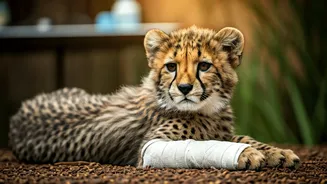
after her birth, Mukhi suffered a serious fracture. This incident was one of six critical medical cases involving five cheetahs since the Project Cheetah initiative began in September 2022. Records indicate a mix of musculoskeletal injuries, including fractures to paws, tails, and upper arms, alongside soft tissue damage, often stemming from high-speed pursuits, altercations, or territorial disputes. Mukhi's specific injury, a complete diaphyseal fracture in her humerus, presented a significant challenge. Initially immobilized with a Robert Jones bandage and supported by anti-inflammatory, analgesic, and antibiotic treatments, along with a calcium and multivitamin-rich diet, her young age was a fortunate factor. However, a subsequent examination revealed displaced fracture segments and a maggot-infested wound on the same limb. This necessitated intensive wound cleaning, antiseptic dressing, and the application of a cohesive body cast, followed by strict enclosure and observation. After months of dedicated care, X-rays in February 2024 confirmed complete healing, marking a crucial victory for the young cheetah and the program.
Agni's Multiple Battles
The cheetah Agni faced a series of severe injuries, highlighting the physical risks inherent in the species' natural behaviors. A dramatic fight between cheetah coalitions, Gaurav-Shaurya and Agni-Vayu, left Agni with extensive wounds, including multiple puncture marks, significant lacerations on its shoulder and thigh, and fractures in both its left forelimb's fourth metacarpal and right hind limb's fourth metatarsal bones. Miraculously, the fractures healed within five to six weeks, allowing Agni to move normally again. However, this was not the end of Agni's medical challenges. Just three months later, the cheetah presented with a severely damaged tail due to a wound. The tissue damage was so extensive that an amputation became necessary. The surgical procedure involved general anesthesia, the creation of a U-shaped flap, ligation of blood vessels, and disarticulation of the tail. Post-surgery care included regular antiseptic dressing, pain relief, and long-acting antibiotics, leading to a complete recovery. Agni was subsequently reunited with its coalition partner, Vayu, demonstrating the program's success in rehabilitating even severely injured animals.
Nirva's Persistent Wound
Nirva, a nearly 3.5-year-old female cheetah weighing 47 kilograms, presented a prolonged and complex veterinary case that became one of the project's most demanding. Initially observed limping on her left forelimb, what started as a seemingly minor paw injury escalated into a protracted battle for healing. Despite initial antiseptic dressing and isolation in a quarantine enclosure, the wound refused to close. Subsequent examinations revealed the development of exuberant granulation tissue on the digits of her fourth toe, and by October 2023, X-rays confirmed osteomyelitis, a serious bone infection. The veterinary team made the difficult decision to amputate the affected digit. The surgery, performed under general anesthesia, involved a precise incision, separation of tendons, ligation of blood vessels, and complete removal of the digit. Following the operation, the exposed bone showed signs of recovery without infection. Retention sutures were used to close the wound, and supportive therapies, including antibiotics, continued. By December 2023, full X-rays indicated normal bone contours and complete wound healing with hair regrowth, confirming Nirva's fitness for release back into the wild.
Nabha's Dental Abscess
Nabha, a six-and-a-half-year-old female cheetah from Namibia, experienced a health scare involving facial swelling that initially mimicked a viral infection. To manage her symptoms, which included elevated body temperature during the summer heat, supportive care was administered, consisting of fluids, antibiotics, and a mist spray. The situation took a more serious turn when she was immobilized again in June 2024, revealing a significant dental issue: a carnassial tooth abscess with a fistula in her left mandibular region. The veterinary team responded promptly with antibiotics, multivitamins, and fluid therapy, which proved effective in helping Nabha recover from this painful condition. The successful treatment of this abscess underscored the team's ability to diagnose and manage a diverse range of health problems impacting the cheetah population.
Aasha's Paw Injury
Aasha, a seven-year-old female cheetah of Namibian origin, faced a challenging situation while nursing her three ten-month-old cubs. She was observed limping, and a clinical examination revealed a broken dew claw accompanied by a maggot-infested wound on her left paw. The maggots were manually removed, and the area was treated with turpentine oil, followed by surgical debridement and antiseptic irrigation. The wound management continued with appropriate medication. By October 29, the wound had cleared, and Aasha received a regimen of long-acting antibiotics, analgesics, multivitamins, a nervine tonic, and fluids. This comprehensive treatment plan was crucial for her recovery, ensuring she could continue to care for her young offspring without compromising her own health.