





Demographic Math Decides
The 2021 West Bengal Assembly elections saw the Trinamool Congress (TMC) secure a clean sweep in 27 seats across Kolkata and Howrah. While often attributed
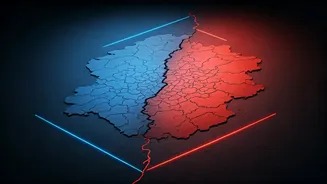
to the TMC's robust election machinery and a cultural resistance to the BJP from the 'bhadralok' class, a closer look reveals that the outcomes in nine of these seats were largely predetermined by demographic composition and differential voter turnout. In urban Bengal, a significant disparity existed between the turnout rates of Hindu and Muslim electorates. Reports from seasoned Bengal journalists indicate Bengali Hindu turnout hovering around 40-45%, whereas urban Muslim turnout frequently exceeded 70%. This divergence, especially pronounced in areas with a substantial Muslim population (under 25%), meant that a given demographic percentage translated into a significantly higher proportion of actual votes cast for the TMC. For instance, a seat with a 25% Muslim demographic share, combined with an estimated 90% Muslim consolidation behind the TMC and a 39% vote share from the majority community, could result in a vote distribution favoring the TMC considerably. The seat-level data, such as in Entally (approx. 40% Muslim population) with a 67.98% turnout compared to Jorasanko (approx. 20% Muslim population) with a 50.08% turnout, clearly illustrates this 17.9-point differential. This demographic arithmetic was a decisive factor in securing victories for the TMC in seats like Kolkata Port, Entally, Beleghata, Ballygunge, Chowrangee, Howrah Madhya, Uluberia Purba, Uluberia Dakshin, and Uluberia Uttar, where the party's victory margins were often bolstered by these underlying electoral currents.
Narrow Margins at Play
Beyond the nine seats where demographic percentages heavily favored the TMC, there were four additional constituencies where the electoral margin was extremely thin, leaving little room for error. These seats, while not entirely decided by pure demographic numbers, were still heavily influenced by them, requiring extraordinary mobilization to bridge the gap. Maniktala, Kashipur–Belgachhia, Panchla, and Howrah Uttar fall into this category. Howrah Uttar, in particular, serves as a case study of the limits of mobilization against a substantial demographic presence. Despite a strong turnout from the Hindi-speaking Hindu community in support of the BJP, which significantly compressed the expected margin, the TMC ultimately held on by a narrow vote of 5,522. This outcome suggests that while robust mobilization can narrow the gap in seats with 25-30% Muslim demographics, overcoming such a threshold solely through mobilization might be exceptionally difficult, if not impossible. The lesson here is that even with strong grassroots efforts, deeply entrenched demographic advantages can still dictate the final result, albeit with tighter contestation.
Bhadralok Theory's Limits
The conventional explanation attributing the BJP's losses to a cultural resistance from the 'bhadralok' (educated Bengali gentry) is an oversimplification that doesn't hold up under scrutiny, especially outside a select few seats in Kolkata. The 'bhadralok' represent a numerically small, albeit influential, segment of society. The average voter in Kolkata is far more likely to be either Hindi-speaking or from the lower-middle-class Bengali Hindu demographic, groups that typically exhibit higher participation rates and are less bound by traditional elite cultural norms. Crucially, ten of the fourteen genuinely contestable seats lie in Howrah district, an area with a distinct socio-economic and demographic profile compared to the historically significant areas of Kolkata often associated with figures like Rammohun Roy and Tagore. Howrah's landscape is characterized by a mix of industrial and semi-rural settings, diverse populations including significant Scheduled Caste presence, and a blend of Hindi and Bengali speakers. In this context, the 'bhadralok' framework offers minimal analytical value. Instead, electoral outcomes in Howrah were more heavily influenced by factors such as organizational strength, the selection of candidates, and effective local mobilization efforts, elements the 'bhadralok' explanation fails to address.
Missed Opportunities: Candidate Selection
The BJP's failure to capitalize on fourteen genuinely contestable seats in Kolkata and Howrah in 2021 was largely a self-inflicted wound, stemming from strategic missteps in candidate selection. While the 2019 Lok Sabha elections saw the BJP surge in West Bengal, achieving a significant vote share increase due to a nationwide 'Modi wave' and anti-Trinamool sentiment, this success did not translate into robust state-level organizational building. The party's strategy in 2021 was marked by a critical misjudgment of its grassroots strength, leading to the onboarding of numerous defectors from the Trinamool Congress just months before the polls. This influx of leaders, often without deep local connections or established party loyalty, resulted in these competitive seats being handed over to individuals with questionable electoral standing or past affiliations. Notable examples include Babul Supriyo losing by a substantial margin in Tollygunge before switching to the TMC, Rudranil Ghosh losing in Bhowanipore, and Rajib Banerjee losing in Domjur before returning to the TMC. The stark contrast between the performance of a local, low-profile candidate in Howrah Uttar (BJP polled 44.12%) versus a TMC defector in adjacent Bally (BJP polled 37%) underscored the impact of candidate choice. In Bally, where demographics were not a decisive lock, the defector candidate failed to consolidate the anti-TMC vote, much of which went to the Left. This strategic reliance on defectors, exemplified by the Singur constituency where a local BJP unit had built a challenger over five years only to see the seat handed to a former TMC MLA, ultimately cost the BJP dearly in these crucial urban seats.
Building the Counterweight
The fundamental reason the BJP faced significant challenges in West Bengal in 2021 was not an insurmountable TMC election machine, but the absence of a comparable counterweight of organizational strength. In states where the BJP has achieved electoral success, it has typically been the result of decades of patient groundwork, building local networks, establishing booth committees, and fostering a ward-level presence where activists intimately know their constituents. This deep organizational fabric, as seen in states like Maharashtra and Karnataka where such work began in the 1970s and 1990s respectively, allows the party to effectively mobilize and challenge established parties. A political machine often appears invincible only when there is no organized force capable of offering a substantial challenge. Historically, states like Odisha presented a similar picture for thirty years before the BJP managed to form a government in 2024, a success built upon decades of consistent grassroots efforts. In 2021, West Bengal had not yet reached that temporal threshold for the BJP. The upcoming 2026 elections signal a potential shift, with a greater emphasis on local figures over defectors, but the crucial question remains whether the organizational infrastructure behind these new candidates is sufficiently robust to penetrate the TMC's stronghold in Kolkata and Howrah.