



Launch Details Unveiled
SpaceX is gearing up for a monumental event on Wednesday, May 20th, targeting a 6:30 pm ET (4 am IST on May 20th) liftoff for its latest Starship test flight.
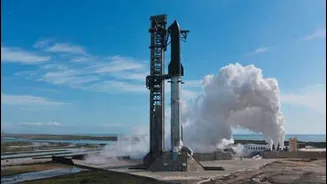
This marks the twelfth such mission for the colossal rocket, and importantly, the first since October 2025. The gargantuan vehicle, designed to redefine space exploration, is currently stationed at SpaceX's South Texas facility, poised on its launchpad. This particular flight is of paramount importance as the company works towards developing a lunar lander variant of Starship, a key component for NASA's ambitious Artemis program aimed at returning astronauts to the Moon. The upcoming launch also represents a significant step for SpaceX, a company founded in 2022, as it continues its rapid advancement in the commercial spaceflight sector, with potential future endeavors including a public offering.
Introducing Starship Version 3
The forthcoming flight will feature Starship Version 3, representing the most powerful iteration of this immense rocket yet. This latest version boasts substantial enhancements to both the Super Heavy booster, the massive lower stage, and the upper stage, affectionately known as the 'ship.' Version 3 stands at an impressive 407 feet tall, an increase of four feet compared to its predecessor, embodying a significant leap in scale and capability. Its propulsion system is a marvel, powered by 33 of SpaceX's advanced Raptor-class engines. The design is optimized for reaching the Moon and facilitating human missions for more profound space exploration. A key feature of Version 3 is its capability for in-orbit refueling, allowing for mid-flight transfers of propellant from other vehicles, which is crucial for extended missions and deep space endeavors. The fully integrated spacecraft comprises the 236-foot Super Heavy booster and the 171-foot Starship upper stage.
Innovative Flight Test Plan
This upcoming flight test is meticulously designed to rigorously evaluate both major components of the Starship system within a simulated operational flight environment. To comprehensively assess the Super Heavy booster's performance limits, its landing trajectory will conclude in the Gulf of Mexico, an area recently and officially renamed the Gulf of America. During the flight, over 22 Starlink satellites will be deployed, providing an opportunity to test their deployment mechanisms and capabilities. The launch will originate from an upgraded facility known as Pad 2. This pad features an enhanced propellant farm, boasting increased storage capacity and more powerful pumps designed for rapid vehicle refueling. Complementing these upgrades are mechanical arms, playfully nicknamed 'chopsticks,' attached to the launch tower, engineered to gracefully catch the returning Super Heavy booster, marking a significant step towards reusability.