







Unveiling Drishti's Vision
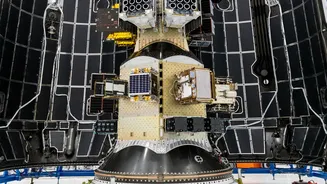
GalaxEye, an Indian startup, has launched Drishti, a revolutionary Earth observation satellite aboard a SpaceX Falcon 9 rocket. This mission represents
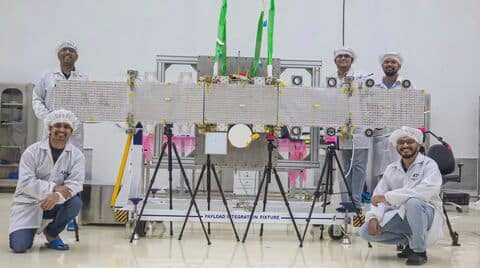
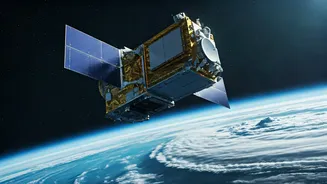
a significant technological advancement, conceived out of India's unique geographical and climatic challenges. Unlike conventional satellites, Drishti is engineered with a dual-camera system, integrating both multispectral imaging and synthetic aperture radar (SAR) capabilities onto a single platform. This combination is a world-first and allows the satellite to capture clear imagery regardless of atmospheric conditions like dense cloud cover or complete darkness. The need for such a capability became apparent when observing the persistent cloudiness over tropical regions, which often hinders the effectiveness of traditional optical satellites. With 70% of the Earth's landmass and 90% of its oceans frequently obscured by clouds, Drishti's ability to penetrate these barriers offers a consistent and reliable stream of data for various critical applications.
Dual Technology Powerhouse
The core innovation of Drishti lies in its fusion of two distinct imaging technologies: multispectral cameras and Synthetic Aperture Radar (SAR). Traditional optical satellites, while providing high-resolution visual data, are severely limited by cloud cover and daylight availability, a significant issue in tropical countries like India where clouds are prevalent. SAR technology, on the other hand, utilizes radar waves to create detailed images of the Earth's surface, functioning effectively through clouds and in the absence of sunlight. By integrating both these systems onto the Drishti satellite, GalaxEye has created a powerful tool capable of providing comprehensive Earth observation data around the clock and in all weather. This unique synergy ensures that users receive uninterrupted, high-quality imagery, essential for applications ranging from disaster response and agricultural monitoring to infrastructure development and national security surveillance, overcoming the limitations faced by existing satellite systems.
A Constellation's Beginning
Drishti is not merely a single satellite; it is the vanguard of an ambitious constellation planned by GalaxEye. The success of this initial launch paves the way for the deployment of nine follow-on satellites, forming a robust network for continuous Earth observation. This first satellite is substantial, weighing approximately 190 kilograms, a weight class traditionally dominated by government missions, underscoring the capabilities of the private sector. Furthermore, Drishti is set to establish new benchmarks in resolution. While many Indian SAR platforms operate at a five-meter resolution, Drishti's initial deployment offers imagery at a 1.5-meter resolution. The subsequent satellites in the constellation are slated to achieve even higher resolutions, aiming for 0.5 to 0.3 meters. Crucially, both the multispectral and SAR systems on Drishti are calibrated to the same 1.5-meter resolution, ensuring consistent data quality across both sensing modalities.
Sovereignty and Innovation
GalaxEye's Drishti mission underscores a strong commitment to technological sovereignty and indigenous innovation. The satellite's proprietary technology, developed entirely within India, has been patented both domestically and globally, signifying its unique value proposition. This groundbreaking development positions India to potentially set a new international standard for Earth observation capabilities. By building these advanced systems in-house, GalaxEye not only ensures control over its intellectual property but also opens avenues for providing sovereign satellite constellations to other nations. The company's roots at IIT Madras, a hub for deep-tech startups, highlight the growing synergy between academic research and commercial space ventures in India. This initiative is a testament to the maturing Indian space startup ecosystem, supported by institutions like ISRO, and showcases the prowess of Indian talent in pioneering advanced space technologies.