
Bullet Train's Journey
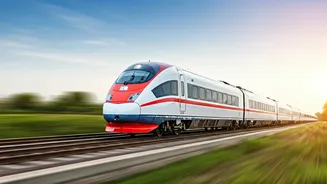
The Mumbai-Ahmedabad High-Speed Rail project, often referred to as the bullet train, is a key component of India's high-speed rail vision. This project aims
to significantly reduce travel time between Mumbai and Ahmedabad to under three hours, a substantial improvement compared to the current six to seven-hour journey on regular trains. The project's genesis dates back to 2013 with a feasibility study completed in December of that year, followed by the submission of a report in July 2015. The Union Cabinet sanctioned the project in December 2015, with an initial completion target of August 15, 2022. However, the project has faced delays, notably due to land acquisition issues in Maharashtra. The official expected completion date is now set for late 2029, with only a segment of the route (Vapi-Sabarmati in Gujarat) anticipated to be ready by December 2027. The total cost of the project has nearly doubled from an initial estimate of Rs 1.08 lakh crore to Rs 1.98 lakh crore.
New Rail Corridors
India's railway ministry is planning to introduce seven new high-speed rail corridors aimed at improving connectivity across the nation. The government is focused on linking major cities in the south and west regions, which are essential economic hubs. The planned routes will connect Mumbai with Pune; Pune with Hyderabad; Hyderabad with Bengaluru; Hyderabad with Chennai; Chennai with Bengaluru; Delhi with Varanasi; and Varanasi with Siliguri. These new corridors, once fully operational, will establish a comprehensive high-speed rail network connecting key cities, which includes a continuous high-speed rail spine linking Ahmedabad with Bengaluru and Chennai. These developments also highlight the ambition to provide environmentally sustainable passenger systems. The Varanasi–Siliguri route is intended to establish a high-speed rail link between Delhi and West Bengal, reducing travel time to Siliguri.
Technical Aspects, Delays
The Mumbai-Ahmedabad High-Speed Rail project will feature trains operating at speeds exceeding 250 kmph. The maximum design speed for the project is 350 kmph, with an operational speed of 320 kmph. The entire corridor is elevated for safety and to save land, with underground stations in Mumbai. The route, spanning 508 km, includes sections through Gujarat (351 km), Maharashtra (156 km), and Dadra and Nagar Haveli (2 km). The foundation stone for the Mumbai-Ahmedabad route was laid in September 2017. Delays have substantially increased project costs, with land acquisition being a major cause. The Vapi-Sabarmati section in Gujarat is anticipated to be ready by December 2027. The final completion of the entire project is expected by the end of 2029. These timelines align with scheduled assembly elections in Gujarat (around late 2027) and Maharashtra (around late 2029).
Vande Bharat Impact
The introduction of high-speed rail is a transformative move. The goal is to provide faster, more efficient travel options across the nation. This ambition reflects the government's aim to modernize India's railway infrastructure and bring it at par with international standards. Delhi and Varanasi already have two Vande Bharat pairs, which reduce travel time to eight hours, a significant improvement compared to the typical 12-13 hour journey on regular trains. This is a step towards offering better connectivity and also ensuring a comfortable and sustainable mode of transport for passengers. The focus on high-speed rail is part of a larger plan to enhance economic growth and improve infrastructure across the country, as highlighted by the Finance Minister in her budget speech.