





Expressway Revolutionizes Travel
The much-anticipated Delhi-Dehradun Expressway is poised to transform intercity travel, significantly reducing the journey time between India's capital
and the popular hill station of Dehradun. Previously a lengthy 6-hour commitment, the new expressway promises to chop this down to a mere 2.5 hours. This remarkable improvement extends to other key routes as well; the travel duration from Delhi to Haridwar is expected to shrink from approximately 5 hours to around 2 hours. This development is set to benefit not only daily commuters and tourists but also enhance overall connectivity to the picturesque regions of Uttarakhand and Uttar Pradesh, making weekend getaways and pilgrimage trips far more accessible.
Route and Connectivity Details
This monumental infrastructure project, constructed at an investment of approximately Rs 12,000 crore, stretches from the Akshardham Temple in Delhi all the way to Dehradun. The route strategically traverses through key towns in Uttar Pradesh, including Baghpat, Baraut, Muzaffarnagar, Shamli, and Saharanpur, thereby improving regional connectivity. Furthermore, the expressway features a dedicated spur that links directly to Haridwar, a crucial gateway for pilgrims. Its design also integrates with the ambitious Char Dham Highway project, which is a significant development for enhancing access to the revered pilgrimage sites and popular hill stations nestled in Uttarakhand and Uttar Pradesh, promising smoother and faster transit for a vast number of travellers.
Speed Comparison: Road vs. Rail
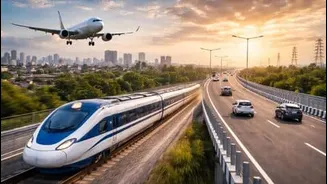
With a stipulated maximum speed limit of 100 kmph, the Delhi-Dehradun Expressway is set to dramatically outperform rail travel in terms of journey duration. The reduction of over 3 hours in travel time between Delhi and Dehradun positions the expressway as the swifter option compared to existing train services. For instance, the fastest train service on this route, the Anand Vihar-Dehradun Vande Bharat Express, currently takes about 4 hours and 45 minutes to cover the 302 km distance, according to IRCTC data. In stark contrast, the new expressway will shave off more than two hours from this journey. This acceleration in travel time is a game-changer for anyone looking to reach Dehradun quickly and efficiently from the National Capital Region.
Extended Trips and Mussoorie Travel
The benefits of the Delhi-Dehradun Expressway extend beyond just reaching Dehradun city; it significantly eases travel to popular nearby destinations like Mussoorie. For those heading to Mussoorie from Delhi, the total journey time could be reduced to approximately 4 hours. This is a considerable improvement when compared to the current travel method involving a train to Dehradun followed by a road trip. For example, taking the Vande Bharat Express to Dehradun (around 4 hours and 45 minutes) and then a 1.5-hour drive to Mussoorie totals about 6.5 hours. The expressway effectively cuts down this combined journey by about two hours, making a trip to the popular hill station much more convenient and time-efficient for travellers.
Cost Analysis: Cab vs. Train
When considering the financial aspect of traveling from Delhi to Dehradun, the expressway offers various options. According to MakeMyTrip, cab fares typically range from Rs 2,734 to Rs 7,409 (excluding additional charges), depending on the type of vehicle chosen. This can be a cost-effective solution for groups. Comparing this to train travel, the Vande Bharat Express offers AC Chair Car seats at approximately Rs 1,075 and Executive Chair Car at Rs 1,900 per person. For a group of four, the cab option emerges as potentially more economical than the Vande Bharat. However, for solo travellers, the Vande Bharat Express generally remains the more budget-friendly choice for this route.
Alternative Train Options
Beyond the Vande Bharat Express, several other train services operate on the Delhi-Dehradun route, offering different travel times and fare structures. The Dehradun Shatabdi Express is one such option, taking approximately 6 hours and 10 minutes for the journey, with fares at Rs 920 for AC Chair Car and Rs 1,420 for Executive Chair Car. Another choice is the Jan Shatabdi Express, which completes the route in about 5 hours and 45 minutes. This train is more economical, with tickets priced at Rs 175 for Second Sitting and Rs 545 for AC Chair Car. These alternatives provide a spectrum of choices for travellers, balancing speed, comfort, and cost based on individual preferences and budgets.
Comparing with Air Travel
For those prioritizing sheer speed over the duration of the journey itself, air travel remains a viable option, albeit with its own set of considerations. A flight from Delhi to Dehradun typically takes around 1 hour and 10 minutes, making it the quickest mode of transport in terms of actual travel time. However, this convenience comes at a higher price point. As of April 12, ticket prices for flights scheduled for April 15 started at approximately Rs 4,089 per person, according to IRCTC. While significantly faster than road or rail, this cost factor makes air travel generally more expensive compared to the other modes of transportation available for the Delhi-Dehradun route, especially when factoring in transit to and from airports.