






A Record-Breaking Lunar Close Approach
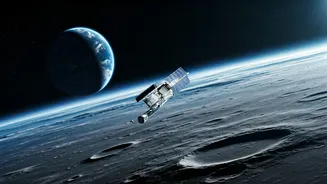
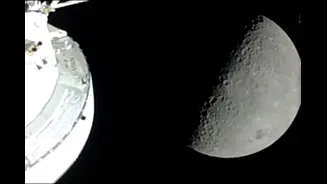
On April 7, the Artemis II mission achieved a significant milestone by performing a close flyby of the Moon, coming within an astounding 4,067 miles of its
surface. During this incredible feat, the four-person crew aboard the Orion capsule journeyed far beyond the Moon's far side, reaching an estimated 252,756 miles from Earth. This distance surpassed the previous record set by Apollo 13 for the farthest humans have ever traveled into the cosmos, marking a monumental achievement in space exploration. The duration of this lunar flyby spanned nearly seven hours, providing astronauts with an extended period to observe and document the lunar landscape from a unique perspective previously inaccessible to humanity.
Unveiling the Moon's Hidden Side
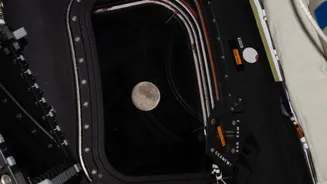
For approximately seven hours during the Artemis II mission's lunar flyby, the astronauts were treated to spectacular, never-before-seen views of the Moon. From their vantage point, they observed about 21% of the Moon's far side bathed in sunlight, a region often referred to as the 'dark side' but which is actually illuminated during different lunar phases. This extended observation period allowed the crew to appreciate the Moon's topography and geological features in unprecedented detail. The mission's success in navigating this close encounter and providing such unique visual data underscores advancements in space travel capabilities and our understanding of celestial bodies.
A Photographer's Celestial Dream
During their historic lunar flyby, the Artemis II crew, comprising NASA astronauts Reid Wiseman, Victor Glover, Christina Koch, and Canadian Space Agency astronaut Jeremy Hansen, were actively engaged in capturing the wonders of space. As revealed by NASA's livestream, the astronauts collectively took close to 10,000 photographs. These images weren't just casual snapshots; the Artemis science team had meticulously trained the crew to identify and document specific lunar features. Their focus included areas shaped by ancient lava flows and the remnants of countless impact craters, providing valuable scientific data alongside stunning imagery. This extensive photographic documentation promises to offer profound insights into lunar geology and history for years to come.
Cosmic Spectacles: Eclipses and Beyond
The Artemis II mission provided its crew with a unique cosmic perspective, offering views of celestial phenomena rarely witnessed by humans. From their close proximity to the Moon, the astronauts observed the lunar disk eclipsing the Sun, a spectacular solar eclipse. During this event, sunlight dramatically emerged from behind the Moon as totality concluded, creating a breathtaking visual. Beyond the Sun, the crew also had the extraordinary opportunity to glimpse other planets like Mars, Venus, and Saturn. Additionally, they observed the soft glow of 'Earthshine,' the light reflected from Earth onto the Moon, and captured a remarkable image of our own Milky Way galaxy on April 7, 2026, further enriching the mission's already impressive visual and scientific returns.