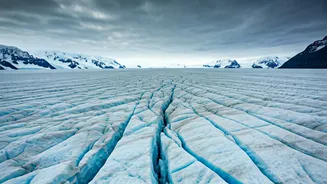







Glacier's Melting Concerns
The Thwaites Glacier, frequently dubbed the 'doomsday glacier,' has captured the attention of scientists and the public due to its rapid melting rate.
This large glacier in West Antarctica holds a significant amount of ice, and its instability raises concerns about rising sea levels. The most recent studies analyze the factors driving the glacier's melting process, including warmer ocean currents and the structure of the glacier itself. These studies have prompted a reevaluation of the glacier's long-term behavior, which has led to some reassuring conclusions as well as some alarming ones. Scientists use advanced techniques and sophisticated models to understand the complexities of Thwaites, aiming to provide a more accurate assessment of its future contribution to global sea level rise. The ongoing research is a critical element in developing informed climate change policies.
Latest Research Insights
Recent research has brought forth new perspectives on the Thwaites Glacier's behavior. One key focus is understanding how warm ocean water is interacting with the glacier's underside. The data indicates that this warm water is causing significant melting from below, which is contributing to the overall instability of the ice mass. Another area of study is the glacier's structure, including crevasses and the underlying bedrock. Scientists are gathering data from various sources, including ice cores, satellite observations, and computer models. These insights help them to forecast the glacier's response to climate change. The combination of oceanographic and geological analysis offers a comprehensive picture of Thwaites, helping researchers refine their projections about its contribution to global sea level rise. These new findings offer a more nuanced understanding of the complexities of the melting process.
Sea Level Impact Explained
The amount of ice contained within the Thwaites Glacier means that its melting has the potential to significantly impact global sea levels. The extent of this impact is one of the key factors that researchers are working to determine. Estimates of the possible sea level rise resulting from the complete melting of the glacier vary, but the potential is substantial. Scientists are using complex climate models to simulate different scenarios, considering the different rates of ice loss and the influence of other factors, such as the thermal expansion of seawater. These models are crucial in projecting the long-term consequences of glacier melting. As scientists continue their work, the information is essential for developing policies to mitigate the effects of climate change and safeguard coastal regions from rising sea levels. Understanding how this single glacier can affect the global landscape is critical to climate change policy.
Future Predictions & Risks
Predicting the future of the Thwaites Glacier involves a number of uncertainties, which keeps scientists on their toes. These uncertainties include the speed and rate of future warming, the glacier's response to changing conditions, and the potential for tipping points. The most concerning scenarios involve the possibility of a rapid collapse, which would lead to a substantial rise in sea levels. However, recent research also provides some reasons for optimism, suggesting that the rate of melting may be less severe than some initial projections. Researchers are continually refining their models and collecting new data to reduce the level of uncertainty. These findings will enable a better understanding of the risks associated with the glacier's melting and the time frames within which these risks might manifest. The evolving understanding of the glacier's fate underscores the complexity of climate change.
Ongoing Monitoring Efforts
Monitoring the Thwaites Glacier is an ongoing, global effort involving scientists from multiple nations, employing various advanced technologies. Satellite imagery provides continuous observations of the glacier's surface and changes in its extent. Researchers also use sensors placed on the ice and in the surrounding ocean to gather data on melting rates, ice flow, and water temperatures. These monitoring efforts provide real-time information and insights into the glacier's behavior. The continual flow of data allows for the refinement of climate models and improves predictions about sea level rise. International collaboration is critical for successful monitoring, enabling a more comprehensive and global approach to tackling the environmental challenges posed by the glacier's melting.