






The Illusion of Movement
In the lush rainforests of Central and South America, a peculiar tree captures the imagination with claims of locomotion. This species, scientifically
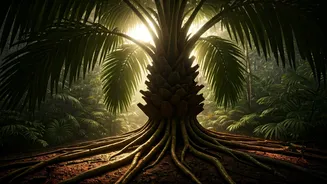
identified as Socratea exorrhiza and commonly referred to as the walking palm, grows in regions like Ecuador, Peru, and Costa Rica. Its distinctive appearance, characterized by a trunk elevated above the ground on a splay of slender roots resembling stilts, fuels the popular notion that it can walk. This visual characteristic sparks curiosity and leads to intriguing, though largely misunderstood, theories about its ability to change its position. The appearance of being on raised stilts is the primary source of this captivating myth.
Root System's Role
The unique structure of Socratea exorrhiza, with its trunk elevated on a network of stilt-like roots, is central to its survival. These roots spread outward, lifting the main trunk off the forest floor. This adaptation is crucial for navigating the often soft and unstable soils found in rainforest environments. Instead of a single, deep taproot, the walking palm distributes its weight across multiple anchor points, much like a creature standing on several legs. This strategy provides enhanced stability, allowing the tree to maintain its position even if the ground beneath it shifts or erodes. The growth and death of these roots, alongside the development of new ones in different directions, contribute to subtle changes in the tree's overall stance over extended periods.
Adaptation vs. Locomotion
Contrary to popular belief, the walking palm does not actively move from one spot to another. While early anecdotal accounts suggested these trees could shift position by a few centimeters daily in pursuit of better conditions, most scientific consensus points to a much simpler explanation. The tree's 'movement' is, in fact, a slow, passive adaptation to environmental changes. As the soil conditions fluctuate or light availability shifts, Socratea exorrhiza responds by growing new roots where support is more optimal and anchoring them in firmer ground. Older roots may lift off the soil, creating the illusion of relocation. This process is an evolutionary response for stability and light, not a deliberate, directional walk.
Stability and Light
The elevated root system of the walking palm serves a dual purpose: enhancing stability and optimizing light absorption. In dense rainforests where sunlight struggles to penetrate the canopy, even a minor alteration in a tree's angle can be significant for its growth. The slow adjustments made by Socratea exorrhiza, driven by its root development, can subtly shift its lean, allowing for improved access to precious sunlight. However, these are gradual adjustments that occur over years, not rapid movements. The tree's ability to adapt its position is a testament to its survival strategy, ensuring it can maximize its chances of flourishing in a competitive ecosystem, a far cry from literal walking.
Limitations of 'Walking'
While the walking palm's ability to adapt its position is an impressive survival mechanism, it is crucial to understand its limitations. The notion of the tree 'walking' implies a speed and agency that it does not possess. Any perceived movement is incredibly slow, occurring over years, and is insufficient to escape immediate threats. For instance, in areas facing deforestation, such as parts of Ecuador's rainforests, these trees cannot relocate quickly enough to avoid being felled. The concept of the walking tree, while enchanting, is more accurately described as a slow, biological adaptation for long-term survival rather than an active form of locomotion.