








An Unseeded Champion's Rise
In 1965, the Badminton Asia Championships in Lucknow witnessed an unexpected triumph as Dinesh Khanna, an unseeded player, carved his name into Indian
sporting history. Having dedicated a year to the sport following an injury and subsequent recovery, Khanna, a civil engineering graduate, was not initially among the top contenders. He entered the championship with modest expectations, primarily aiming to observe and learn from the world's best badminton players. His journey to the finals was a testament to his defensive prowess and resilience. He faced seasoned opponents, including the tenacious Yoshinori Itagaki, nicknamed 'Bouncing Ball' for his relentless retrieving. Khanna's strategic approach, focusing on rest over intense physical training off-court, contrasted sharply with his opponents' rigorous routines, yet proved effective. His victory over Itagaki, sealed with a clever backhand during grueling rallies, showcased his mental fortitude. This unexpected progression to the semifinals, where he defeated Suresh Goel, another strong Indian player who had ousted the top seed, was a surreal experience for Khanna, transforming him from an observer to a finalist.
The Unconventional Prize
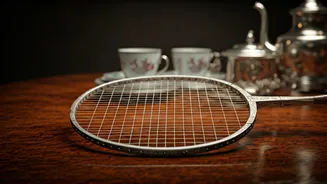
Following his momentous victory at the 1965 Badminton Asia Championships in Lucknow, Dinesh Khanna was presented with prizes that, while symbolic of his achievement, proved rather impractical. The most memorable of these was a white metal tea set. Khanna later recounted how his wife found it difficult to use or display, ultimately leading to its disposal. Adding to the peculiar nature of his win, the coveted rolling trophy, a symbol of badminton supremacy, was not permanently awarded. Instead, it was intended to be a keepsake for the next Asian champion. This tradition meant that Khanna, despite being the reigning champion, did not get to keep the main trophy. The situation was further compounded by the fact that his gold medal, while acknowledged on his Wikipedia page, was not physically presented to him, leaving him with scant tangible mementos of his historic feat. This experience highlights a less glamorous, almost quirky aspect of sports accolades from that era, contrasting with the immense pride of his championship title.
A Legacy Endures
Dinesh Khanna's singles victory at the 1965 Badminton Asia Championships remains an unparalleled achievement for India, standing as the country's sole singles title in the championship's history. Decades later, the wait for another Indian singles champion continues, with players like Lakshya Sen now aiming to break this 61-year-long drought. While Indian doubles pairs like Satwik and Chirag have achieved success, the singles title remains elusive. Khanna's win in Lucknow, achieved as an unseeded player and followed by another significant victory at the Nehru Memorial tournament shortly after, cemented his place in Indian badminton lore. His strategic approach, calm demeanor, and the memorable anecdote of the tea set prize, all contribute to the enduring narrative of his championship. The inspiration drawn from sporting legends like K.D. Singh Babu, who had won Olympic golds, played a role in Khanna's mindset before the final, fueling his determination. His unique defensive style and his witty response about choosing 'non-violence' when questioned about his defensive play further add to the colorful tapestry of his career, making his 1965 triumph a story that continues to resonate.