






Unprecedented Girder Launch
The National High-Speed Rail Corporation Limited (NHSRCL) has achieved a significant milestone in the development of India's inaugural bullet train corridor,
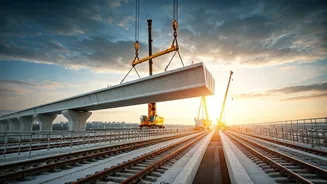
the 508-km Mumbai-Ahmedabad project. This ambitious undertaking, spanning across Gujarat, Maharashtra, and the Union Territory of Dadra & Nagar Haveli, saw the successful erection of one of the heaviest girders ever installed on the nation's railway infrastructure. Specifically, a precast-prestressed portal beam, weighing an astonishing 1,360 metric tonnes and measuring 34 metres in length with a cross-section of 5.5 by 4.5 metres, was expertly positioned over the Amdavad-Vadodara railway line in Maninagar, Gujarat. The NHSRCL's plan includes the installation of five such massive beams in close proximity to the Maninagar railway station, with these structural components being precast on-site and then erected as integrated units, showcasing a streamlined construction methodology.
Record Time Efficiency
What makes this particular girder launch truly exceptional is the astonishing speed at which it was executed. The entire operation, from commencement to completion, was finalized in a remarkable 3.5 hours. This swift accomplishment was made possible through meticulous planning and careful coordination with Indian Railways, ensuring a full traffic and power block was in place. Previously, similar endeavors of this magnitude were anticipated to require significantly longer periods, potentially extending to six months with blocks lasting nearly 9 hours. The NHSRCL's optimized approach drastically reduced the execution time for both railway lines along the Amdavad-Vadodara section, demonstrating a remarkable leap in construction efficiency and project management for high-speed rail development.
Engineering Prowess Unleashed
The successful lifting and placement of the 1,360 MT girder were a testament to sophisticated engineering capabilities. A powerful 2,200 MT crawler crane served as the primary lifting equipment, with crucial support from auxiliary machinery including a 260-ton standby crane, an 80-ton crane, personnel lifters, and a specialized lifter beam system equipped with anchoring frames. To manage the immense weight, the lifting arrangement incorporated 75 mm diameter prestressed macalloy bars, along with robust lifting beams and heavy-duty slings, all meticulously designed to ensure the safe handling of the colossal load. This operation presented formidable engineering hurdles, not least of which was managing an ultra-heavy lift of approximately 1,360 MT over active Indian Railways tracks, coupled with the critical requirement to complete the entire erection within a constrained timeframe.