
The Circular's Mandate
A recent directive from Central Railway's Principal Chief Operations Manager, identified as Correction Slip 15, introduced revised protocols for communication
between train guards and motormen while trains are in motion. This updated procedure mandates that as a train approaches its designated stop, the guard must initiate an advance bell signal to the motorman. This signal is intended to provide the motorman with sufficient forewarning to anticipate the stop and commence braking operations smoothly. Crucially, the circular stipulates that if the motorman does not respond adequately and the train's speed remains too high as it nears the station, the guard is empowered to apply the emergency brakes independently. This revised protocol stems from recent incidents where trains overshot platform limits, prompting internal safety reviews and a desire to enhance preventative measures against potential accidents.
Guard's Crucial Role
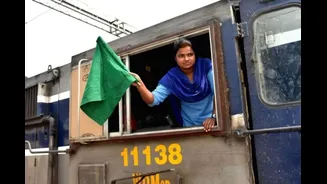
While many commuters might perceive the train guard as merely the individual waving a flag at the rear, their responsibilities are far more extensive and vital to train operations. Stationed in the final coach, guards are instrumental in signaling the 'all-clear' for departure after ensuring passengers have boarded safely. They maintain communication with the motorman through a distinct series of bell codes, where two bells signify readiness to proceed and one bell indicates an immediate stop is required. Beyond these basic signals, guards are continuously vigilant throughout the journey, monitoring the train for any anomalies, such as unusual noises or signs of brake binding, and relaying these observations to the motorman. In situations where a train is approaching a station at a speed exceeding 40 kmph, guards possess the authority to deploy emergency brakes. Their duties also encompass verifying the functionality of essential equipment like the public address system, flasher lights, and tail lamps.
Guard's Grievances Unpacked
Train guard associations have voiced significant dissatisfaction, arguing that the new circular imposes additional responsibilities onto a role that is already physically and mentally demanding. Guards typically undertake eight-hour shifts that often involve complete round trips without any scheduled breaks, necessitating sustained concentration for the entire duration. These arduous conditions are exacerbated during the summer months when internal temperatures within coaches can become exceptionally high. Members of these associations express that adding further duties without addressing pre-existing concerns about workload and working conditions is inequitable. Furthermore, guards have pointed out that Western Railway already implements a comparable advance-signaling practice, yet incidents of overshooting platforms have still occurred, suggesting the new measure may not be a definitive solution. This leads them to believe that the circular places an undue burden without guaranteeing enhanced safety outcomes.
Railway's Safety Focus
Railway officials have reiterated that the new circular is fundamentally a safety enhancement measure, not an attempt to overburden the guards. They maintain that guards, being intimately familiar with their routes and capable of accurately judging distances between stations, are well-positioned to implement the advance signaling protocol. This, they argue, serves as an essential preventive step, introducing an additional layer of security to train operations. To further bolster safety and coordination, Central Railway has recently deployed a GPS-based Signal Location Announcement System, known as SILAS, on its suburban trains. SILAS alerts motormen at specific distances (350 meters and 250 meters) before upcoming signals, thereby minimizing the potential for human error. This system also informs the motorman of the next scheduled halt based on the route selected by the guard, fostering greater synergy between the two roles. A scheduled meeting between Central Railway management and representatives from the Central Railway Mazdoor Sangh is set to address these concerns.