






Botanical Berry Basics
Our everyday understanding of fruits is often shaped by appearance and taste. We tend to label small, juicy fruits as 'berries'. However, botanists employ
a different, more precise definition based on a fruit's developmental process. At its core, a fruit is essentially the mature ovary of a flowering plant. Within this botanical framework, 'true berries' possess specific characteristics: they must develop from a single flower that has a solitary ovary, and their seeds must be entirely enclosed within the fruit's flesh. This scientific lens is crucial for understanding why our common fruit names don't always align with their biological classifications. It's a fascinating distinction that often surprises people, leading to common misconceptions about familiar fruits.
The Banana's Berry Status
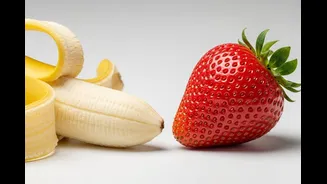
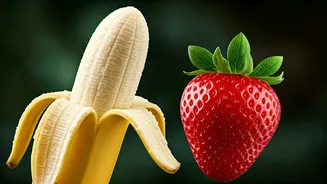
Bananas, by botanical standards, are indeed true berries. Their growth pattern perfectly matches the scientific criteria. Each banana develops from a single flower with one ovary, and the fruit itself has a soft peel, succulent interior, and numerous small seeds embedded within its flesh. Even though these seeds are often minuscule and not readily apparent in cultivated bananas, their presence aligns with the botanical definition. Consequently, bananas comfortably fit into the 'berry' category. This classification extends to other familiar fruits such as grapes, tomatoes, kiwis, and even avocados, all of which also develop from a single ovary and meet the criteria for being true berries.
The Strawberry's Aggregate Nature
In contrast to the banana, the strawberry follows a different developmental path. It does not originate from a single ovary. Instead, strawberries emerge from flowers that comprise multiple ovaries. This unique reproductive structure is the reason why strawberries exhibit a characteristic appearance, with tiny yellow structures on their exterior. These are not true seeds but rather small individual fruits derived from each separate ovary. Because of this origin from multiple ovaries, strawberries are scientifically classified as 'aggregate fruits,' rather than true berries. This distinction highlights the divergence between common culinary or visual categorizations and the precise botanical definitions.
Historical Naming Conventions
A significant part of the confusion surrounding fruit classifications stems from the historical evolution of fruit naming. Many fruits were given common names long before botanists established formal, scientific classification systems. This historical practice often resulted in names that did not accurately reflect the botanical characteristics of the fruits. Consequently, the everyday names we use for fruits, like 'strawberry,' do not always correspond with their scientific botanical definitions. This leads to situations where a fruit like the banana is scientifically a berry, yet it is not commonly perceived as one due to these long-standing, non-botanical naming conventions that have become deeply ingrained in our language and understanding.