







The Venusian Snap
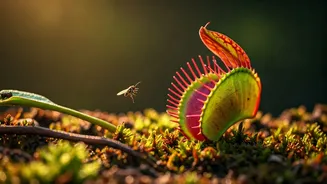
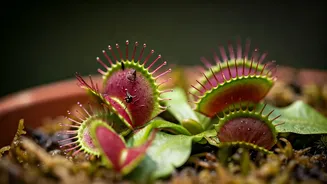
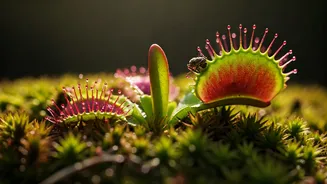
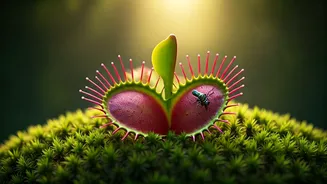
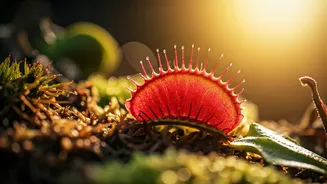
The Venus Flytrap stands as the undisputed celebrity of the carnivorous plant world. Its fame stems from an incredibly rapid and precise trapping mechanism.
Tiny, sensitive trigger hairs located within the plant's leaf lobes act as the bait. When an unsuspecting insect brushes against these hairs twice in quick succession, the lobes snap shut with astonishing speed, forming a cage from which there is no escape. This swift action ensures that the prey is secured, allowing the plant to begin its digestive process and extract vital nutrients. This iconic plant demonstrates a highly evolved predatory strategy, showcasing nature's ingenuity in overcoming environmental limitations.
The Pitfall Prowess
Pitcher Plants employ a passive yet effective predatory technique, relying on their uniquely modified leaves that form deep, pitcher-like structures. These elaborate traps are often adorned with alluring scents and vibrant colors to attract insects. The interior walls of the pitcher are typically slippery, coated with a waxy substance or downward-pointing hairs, making it nearly impossible for an insect to climb out once it has fallen in. At the bottom of the pitcher, a pool of digestive enzymes awaits, ready to break down the captured prey. This ingenious design turns a seemingly passive plant into a highly successful hunter of unsuspecting invertebrates.
Glistening Sticky Traps
Sundews, with their delicate yet deadly beauty, utilize a mesmerizing sticky trap. Their leaves are covered in numerous tentacle-like glands that exude a glistening, dew-like substance. This sticky fluid serves a dual purpose: it attracts insects with its appearance and scent, and then ensnares them upon contact. Once an insect becomes stuck, the surrounding tentacles slowly bend and curl inwards, further immobilizing the prey and bringing it into contact with digestive secretions. This slow, methodical approach ensures that even the most persistent insect is eventually captured and consumed, highlighting the plant's patient and effective hunting strategy.
Greasy Leaf Ambush
Butterworts present an intriguing trapping method centered around their uniquely textured leaves. The surface of a butterwort leaf feels noticeably greasy to the touch, a characteristic that proves irresistible to small insects. This tackiness is due to specialized glands that secrete a sticky mucilage. When an insect lands on the leaf, it becomes stuck in this adhesive substance. Digestive enzymes are then secreted directly onto the trapped prey, breaking it down and allowing the plant to absorb the essential nutrients. This seemingly simple, adhesive surface transforms the entire leaf into a highly efficient, albeit unconventional, carnivorous trap.
The Swift Sucker
Bladderworts are renowned for their astonishing speed and their mastery of aquatic predation. These remarkable plants possess numerous small, bladder-like structures that function like miniature vacuum cleaners. These bladders maintain a negative pressure, creating a constant suction. When a tiny aquatic organism swims too close to the bladder's opening, a specialized trapdoor is triggered, and the prey is instantly sucked into the bladder in a matter of milliseconds. This incredibly rapid mechanism is one of the fastest in the plant kingdom, allowing bladderworts to efficiently capture small prey in their watery habitats.
The Deceptive Cobra
The Cobra Lily boasts a visually striking resemblance to a venomous snake, and its trapping mechanism is equally ingenious and deceptive. This plant features a hooded structure, often with a forked 'tongue' and alluring markings. Insects are drawn into the hood, where they encounter a confusing array of false exits. While attempting to escape, they inevitably fall into the digestive fluid at the base of the pitcher. This clever design plays on the insect's instinct to flee, ensuring they are trapped until they are broken down and their nutrients absorbed by the plant.
Underwater Snap
The Waterwheel Plant, an aquatic relative of the familiar Venus Flytrap, showcases a remarkable underwater trapping system. This rare plant consists of a central whorl of leaves that form a wheel-like structure. Each leaf is equipped with sensitive trigger hairs and hinged lobes. When small aquatic organisms or insects come into contact with these hairs, the lobes snap shut, ensnaring the prey within the underwater trap. This adaptation allows the Waterwheel Plant to capture tiny aquatic life, demonstrating its predatory capabilities in a submerged environment.
Australian Pitcher
The Albany Pitcher Plant, originating from Australia, presents a more miniature yet equally effective carnivorous strategy. This species features small, bell-shaped pitcher traps that are adept at luring and capturing small insects. The plant's evolutionary path has led to the development of these diminutive pitfall traps, which are highly efficient in its native environment. Once insects are drawn in by the plant's allure and slip into the pitcher, they are trapped by the slippery interior and ultimately digested by the plant's enzymes, enabling it to thrive in nutrient-poor soils.
Tropical Giants
Among the most dramatic and impressive carnivorous plants are certain species of Tropical Pitcher Plants, particularly those from the Nepenthes genus. Some of these exotic varieties grow to considerable sizes, developing pitchers large enough to capture not only insects but also more substantial prey such as frogs, lizards, and even small mammals. These oversized traps are a testament to the extreme evolutionary adaptations these plants have undergone to secure nutrients in challenging environments, showcasing a truly formidable predatory prowess that sets them apart in the plant kingdom.