







Ancient Origins Revealed
The journey of the safety pin stretches far back in history. In ancient times, the concept of a pin for fastening was already in use. Known as fibulae
in Latin, these early pins trace their roots to the Bronze Age in Europe. However, these were very different from the safety pins we know today. These early designs were primarily used for fastening clothing or other items, showcasing the rudimentary beginnings of what would later become a ubiquitous tool. This shows how necessity truly is the mother of invention, with early humans figuring out practical solutions to everyday needs.
Evolution of Design
The safety pin has an intriguing evolution. The design of these pins varied. For example, Central European, Greek, and Italian traditions favoured pins closer to the modern safety pin. These pins were crafted from a single wire, featuring a spring in the centre to allow flexibility. A sharp end was designed to easily insert, while the opposite end was bent, creating a secure closure. This spring-loaded design was a leap forward in terms of safety and functionality. This transformation, from a basic fastening tool to a more secure and user-friendly version, highlights the continuous refinement of everyday objects.
Hunt’s Clever Invention
The modern safety pin as we know it today was the brainchild of Walter Hunt in 1849. He ingeniously crafted the design by bending a single piece of wire to form a spring-loaded mechanism. This single act was a transformative moment, simplifying the design and introducing the security that defines the safety pin. This approach showcased his understanding of materials and a knack for innovative solutions. His invention offered significant improvements in terms of both safety and ease of use, making it a pivotal moment in the history of fastening tools.
Decoding the Mechanism
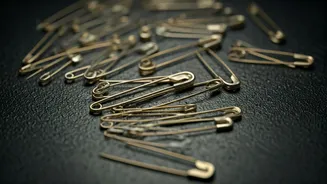
The functionality of the safety pin lies in its construction. Examining the pin closely reveals two key parts that are essential to its function. At the base, the wire is bent into a loop or coil, acting as a spring. This spring produces tension, holding the sharp tip firmly in place, and preventing accidental openings. Without this tension, the pin would be far less secure and could pose a risk of injury. This clever mechanism transforms a simple piece of wire into a reliable and safe fastening device, showcasing the power of well-considered engineering.
Two Distinct Methods
At the time of its evolution, two dominant approaches existed for making pins. The first, employed in Northern Europe, used a two-part construction without a spring. One part featured a hole, while the other would pass through and secure itself. This intricate design, which predated the modern safety pin, offered a different approach to fastening, but lacked the elegance and safety of Hunt's spring-loaded design. While functional, it was more complex and less intuitive than the streamlined solution that would later revolutionize the industry.
Hidden Ingenuity Unveiled
The safety pin is a testament to the idea that smart engineering can be hidden in plain sight. It seamlessly combines two simple parts to achieve its function. It works in perfect harmony, turning a sharp risk into a secure design. It reveals the intelligence behind a seemingly simple tool. These small details often go unnoticed in everyday life. Understanding its construction provides a new appreciation for the cleverness of seemingly ordinary things. Its design is a perfect example of functionality meeting practicality.