





Understanding Emergency Quota
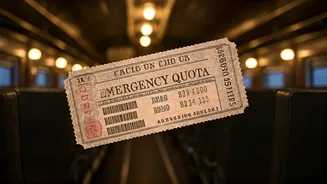
Indian Railways offers a special 'Emergency Quota' (EQ) to facilitate travel for individuals facing urgent situations. This isn't a general booking option;
it's a carefully managed system reserved for specific passenger categories whose travel needs cannot be met through regular booking channels. The EQ aims to address situations where individuals are waitlisted but have compelling reasons to travel. These special booking cells are strategically located at Zonal and Divisional Headquarters, as well as at select prominent stations that are not headquarters. The primary objective is to provide a lifeline for urgent journeys, ensuring that essential travel is not obstructed by standard waiting lists. It's a crucial mechanism that underscores the railway's commitment to passenger welfare in times of immediate necessity, ensuring that critical travel plans can still be actualized.
Eligibility Criteria Explained
Access to the Emergency Quota is strictly defined and prioritized for specific individuals. Primarily, it's allocated to High Official Requisition (HOR) holders, a category that includes esteemed individuals such as Central Government Ministers and Judges of the Supreme Court and various High Courts. Members of Parliament also fall under this privileged category. Beyond these high-ranking officials, the quota extends to accommodate other emergent demands for passengers who find themselves on the waiting list. The national transporter meticulously considers requisitions from various sources, releasing the remaining EQ based on a set of crucial factors. These include the passenger's official status, the sheer urgency of their travel, whether it's for official government duty, a family bereavement, a sudden illness requiring immediate attention, or an important job interview. This ensures that the limited accommodation is utilized for genuinely critical travel needs.
The Approval Mechanism
The process by which Indian Railways approves Emergency Quota requests is a structured and priority-driven system. Given the high volume of applications received daily from diverse sources, a clear hierarchy is followed. As stated by the Railway Minister, the initial allotment is strictly reserved for the self-travel of HOR holders and Members of Parliament, adhering precisely to their established inter-se seniority as per the Warrant of Precedence. Once these primary requisitions are accommodated, the railway then examines other requests. This includes those submitted by Members of Parliament and various other quarters. The release of the remaining EQ is a nuanced decision, taking into account multiple variables. These variables are critical for determining the legitimacy and urgency, encompassing factors like the official standing of the passengers, the nature of their journey such as travelling for government assignments, a deeply regrettable family bereavement, a serious medical condition, or attending a pivotal job interview. This systematic approach ensures fairness and prioritizes genuine emergencies.
Ensuring Authenticity of Requests
To safeguard the Emergency Quota from any potential misuse by individuals with ill intentions, the Railway Board has implemented stringent protocols. It is imperative for all Zonal Railways to release seats under the EQ only when official written requests are received from legitimate sources. This measure is designed to prevent fraudulent claims and ensure that the limited availability is reserved for those who truly meet the eligibility criteria and have a genuine, urgent need to travel. By mandating written requisitions, the Indian Railways creates a clear audit trail, enhancing transparency and accountability in the allocation process. This system reinforces the integrity of the Emergency Quota, ensuring it serves its intended purpose of facilitating critical travel for deserving passengers without being exploited.