






The Final Act
The air crackled with anticipation, a tangible weight settling over the site after more than five hours of relentless work. Workers, their eyes heavy with fatigue
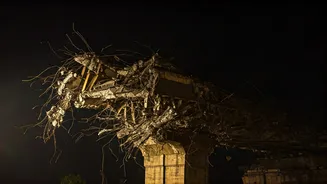
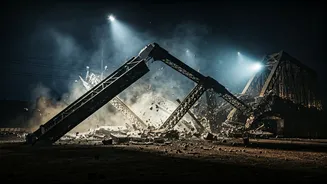
and legs yearning for rest, found solace only in brief interludes for chai and cigarettes. A shared sense of unvoiced impatience permeated the dust-filled atmosphere, visible in their expectant gazes and the weary shifting of feet. All attention was fixed on a lone welder, precariously positioned on a ladder, meticulously severing the final, stubborn inch of a massive 30,000-kilogram girder. This thick steel section, the anchor of the 37-metre structure, stubbornly resisted separation. As dawn approached, the welder descended, and phones were raised. The command, 'rassa pakdo' (hold the ropes), echoed, instructing workers to manage the girder's controlled descent. A final, determined push with a crowbar from the east end tipped the colossal piece. The sky, now bright with morning, exploded in a burst of fireworks, a pre-arranged salute to the successful, albeit hard-won, conclusion of a three-month effort to bring down a 112-year-old relic.
A Bridge's Legacy
For over a century, the Elphinstone Bridge was far more than just a physical structure; it was an integral part of Mumbai's daily life, a vital artery connecting the city's eastern and western halves, bisected by the ever-present railway lines. Its dual access to Prabhadevi and Parel stations made it a sought-after location for modern office developments. Commuters flowed ceaselessly across it, forming queues for shared taxis beneath its welcoming arches, while spirited debates and casual chai sips unfolded against the backdrop of its sturdy, fort-like basalt walls. However, the relentless march of time and the city's insatiable demand for speed meant its days were numbered. In September 2025, the bridge was permanently closed, a symbolic representation of Mumbai's ongoing transformation, where traditional basalt gives way to modern concrete and the old is superseded by the new. Its replacement is envisioned as a double-decker marvel, designed to streamline traffic and integrate with major infrastructure projects, promising a future where journeys across the city are measured in minutes.
Engineering Hurdles Unveiled
The initial blueprints from 1911 revealed a natural division in the bridge's design, comprising three segments separated by two joints. Two of these segments featured seven panels each, while the third had eight, leading engineers to plan a dismantling process involving 28 individual parts. However, two significant complications emerged that complicated the demolition. Firstly, the bridge spanned eleven active railway tracks, necessitating work only within the extremely narrow three-hour window between the last and first trains of the night, or during infrequent, extensive blocks that would disrupt the city's critical rail network. Secondly, years of train operations had caused the overhead electrical (OHE) wires, responsible for powering trains, to creep upwards and become ensnared with the bridge structure. Project manager Anirudh Sharma explained that the bridge's low clearance of merely 5.5 meters, combined with the gradual elevation of the railway tracks, resulted in the catenary wire becoming intricately interwoven with the bridge. Sharma's innovative solution involved a temporary beam to suspend the OHE wires while panels were removed from beneath, a concept inspired by a clothesline advertisement, which eventually gained approval from Western Railway.
Navigating Railway Lines
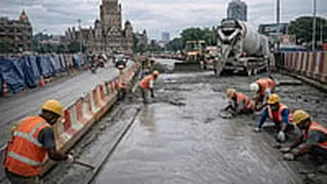
The demolition process encountered several setbacks before finding its rhythm. The initial attempt on New Year's Eve proved unsuccessful, failing to progress beyond the initial stages. A subsequent attempt on January 3rd, during a rare 12-hour maintenance window, proved overly ambitious; precious hours were consumed by the intricate maneuvering of the crane, followed by a tense standoff with local residents. Despite these early challenges, a steady operational cadence gradually emerged throughout January. Nights were dedicated to carefully cutting the edges of the bridge panels, leaving only the four corner connections intact to maintain structural integrity. This meticulous preparation paved the way for the final stages, culminating in the successful removal of the span over the Western Railway lines, facilitated by the reliable temporary OHE support system.
The Central Stalemate
While the dismantling over Western Railway tracks neared completion, the demolition of the bridge section spanning Central Railway tracks faced significant delays, essentially stalled before it could truly commence. The primary obstacle was the crucial temporary OHE arrangement. Despite its proven effectiveness on Western Railway, Central Railway officials expressed serious reservations regarding its safety, citing a lack of prior testing on their specific tracks and demanding extended block times for OHE work. Initially, Central Railway mandated 12-hour blocks, then escalated to six-hour 'megablocks' per panel, effectively doubling the time required for the same task on Western Railway lines, feasible only on weekends. The prolonged delays incurred substantial financial costs, with the 800-metric-ton crane remaining idle for approximately Rs 80 lakh per month, a figure that represented half the total dismantling contract cost. By February 15, project managers Mishra and Sharma considered abandoning the effort due to the insurmountable bureaucratic hurdles and the escalating expenses.
Resolution and Final Push
A turning point arrived when the Managing Director of MRIDC intervened, facilitating a meeting with Central Railway's Divisional Railway Manager (DRM). This intervention led to a shift in Central Railway's stance, with Western Railway officials being tasked to lead the initial dismantling phase. Subsequently, Central Railway agreed to a more cooperative approach. They permitted a block for demolition on the very night of their agreement, though MRIDC requested a day for preparation. Another night was lost when the crane operator was involved in a road accident en route to the site. However, once operations resumed, progress was swift. The final megablock, scheduled for the night of April 5th, was designated for the removal of the last girders. The process mirrored the final moments described earlier: the welder completing his task, the crowbar's decisive action, the girder's controlled swing, and the eventual, triumphant fireworks display, signifying the complete demolition of the 112-year-old structure.