
Cosmic Time Capsules
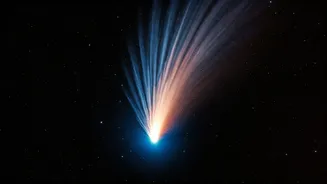
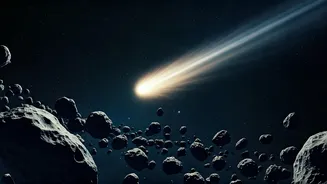
Comets and asteroids are essentially time capsules from the early solar system. They are remnants from the period when our sun and planets were forming,
providing a snapshot of the materials that existed billions of years ago. These space rocks are composed of materials like ice, dust, and rock, with their composition varying based on their formation location. Comets, originating in the icy outer reaches of the solar system, often contain frozen gases, while asteroids, found primarily in the asteroid belt between Mars and Jupiter, are rocky remnants. Studying these celestial bodies allows scientists to understand the conditions and processes that occurred during the solar system's birth. Examining their composition helps to determine the building blocks of planets and the availability of key elements for life, such as water and organic compounds. The age and state of preservation of these objects make them valuable research subjects.
Life's Building Blocks
Asteroids and comets potentially delivered essential materials for life to Earth. Scientists believe that comets, in particular, may have brought water and organic molecules to our planet, seeding it with the ingredients necessary for life. These objects have been found to contain a variety of complex organic compounds, including amino acids, the fundamental building blocks of proteins. The impact of comets and asteroids on early Earth could have delivered these organic molecules, initiating the prebiotic chemistry that eventually led to the emergence of life. Research into comets and asteroids is vital to understanding the origins of life and its distribution throughout the universe. Moreover, the study of the water and organic material within these celestial bodies helps us understand how habitable environments form in other planetary systems.
Death from Above?
While offering insights into life's origins, comets and asteroids also pose potential threats. Earth has experienced numerous impacts throughout its history, some of which have caused mass extinction events. The most well-known example is the impact that led to the extinction of the dinosaurs. Studying the orbits and characteristics of near-Earth objects is critical for assessing and mitigating these risks. Scientists monitor these objects, calculating their trajectories and assessing the probability of future impacts. Various strategies have been proposed to deflect or destroy threatening asteroids and comets. These include using kinetic impactors, nuclear explosions, and gravitational tractors. The goal is to prevent a catastrophic impact by altering the object's path. International cooperation and continuous monitoring are essential for protecting our planet from potential cosmic threats, highlighting the importance of ongoing research and planetary defense initiatives.