






A Traveler's Ordeal
A distressing incident recently unfolded for an Indian tourist traveling from Cambodia to Laos. While transiting through Luang Prabang International Airport,
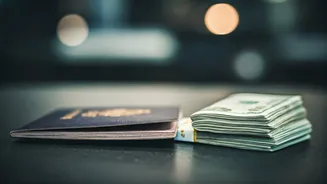
she was unexpectedly denied boarding by airline officials, who demanded she produce $400 USD in cash. This demand came as a shock, especially as she had successfully entered Cambodia just weeks prior using a credit card for her visa-on-arrival, with no issues. Despite offering extensive proof of her financial stability, including bank statements and a documented travel history, the airline staff remained inflexible. The traveler expressed her frustration, noting the lack of clear official documentation for this requirement, with airline staff citing information from informal group chats. She also recounted a previous border crossing experience into Laos from Cambodia, where she was compelled to purchase a return flight ticket, hinting at a broader concern among authorities about potential illegal immigration and employment.
Shared Experiences and Scrutiny
Following the traveler's account, numerous other individuals shared their own encounters with similar demands. One passenger recounted being asked to show $800 in cash when flying from Bangkok to Cambodia, observing that a Chinese tourist with them was exempt from this rule, facing no such scrutiny. Another traveler, identifying as Chinese, detailed being asked for $500 USD to fly from Cambodia to Thailand and facing immigration requests for return tickets upon entering Cambodia. This disparity in treatment and the anecdotal evidence suggest that travelers from certain nationalities might face more stringent checks. One comment even attributed these stricter entry rules to a perceived 'supremacist attitude' of Indian travelers, labeling India as a 'third world' country and advocating for acceptance of stricter immigration policies.
Official Guidelines vs. Reality
According to the Indian Ministry of External Affairs' website, Cambodia offers a visa-on-arrival facility for Indian nationals for tourism and business. The documented requirements for this include confirmed hotel bookings or accommodation details and return flight tickets. However, the MEA also notes that Cambodian Immigration Police *may* request proof of funds, specifically mentioning a minimum of $500 USD per passenger. Intriguingly, the MEA's listing for Laos under countries providing visa-on-arrival has a blank entry regarding cash requirements. This suggests a potential discrepancy between official documentation and the on-ground enforcement practices by immigration and airline officials, leading to confusion and distress for travelers.
Expert Insights on Proof of Funds
GS Bawa, Secretary General of the Air Travellers Association and former GM of the Airports Authority of India, shed light on the situation. He clarified that there isn't a universally mandated official law requiring travelers to carry a specific amount of cash, such as $400 USD. However, he confirmed that Cambodian immigration officers do possess the discretion to ask for proof of funds to ascertain a traveler's genuine tourist intent and ability to self-sustain during their stay. This proof can encompass not only cash but also credit cards and bank statements. Bawa indicated that while not a strict rule, travelers from certain nationalities might indeed be asked to demonstrate anywhere from $500 to $1000 USD. He emphasized the importance of carrying crisp, clean USD notes, as damaged bills are often rejected, and advised travelers to be aware of declaration rules for amounts exceeding $10,000 USD.
Strategic Travel Planning
Bawa further explained that countries implement such checks based on their experiences with various traveler demographics, often in their own interest and for the safety of incoming visitors. To mitigate inconvenience for genuine travelers, he advocated for clearer and more strategic dissemination of these rules. Travelers should be informed in advance about specific requirements, including what is expected and what actions to avoid. He also pointed out that in countries with less robust digital transaction infrastructure, a demand for visible cash might be a more common practice. Ultimately, Bawa stressed that strategic planning encompassing visas, immigration requirements, and currency management is crucial for a smooth international travel experience.