
Defining the Cholas
The Chola Empire, a significant dynasty in South India, played a pivotal role in shaping India's historical maritime presence in Southeast Asia. This empire,
which ruled from around the 9th to the 13th centuries, wasn't just a land-based power; it possessed a formidable navy that facilitated its expansion and influence. They ruled a large part of present-day Tamil Nadu, and their influence stretched far beyond, impacting trade, culture, and politics across the Indian Ocean. Understanding the Chola Empire involves examining its administrative structure, military strategies, economic systems, and cultural achievements. Their success stems from a sophisticated understanding of naval warfare, which allowed them to control critical sea routes and project power across vast distances. This control was essential for facilitating extensive trade and cultural exchanges, leaving a lasting legacy in the regions they interacted with.
Naval Prowess Explained
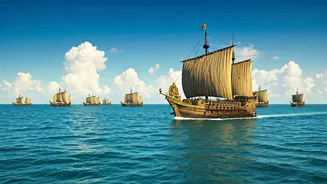
The Cholas' remarkable naval strength was a cornerstone of their regional dominance. Their navy was not only a military force but also a tool for commercial and cultural expansion. The Chola fleet comprised a variety of vessels designed for different purposes, including warships, transport ships, and support craft. These ships enabled the Cholas to control crucial sea lanes, secure trade routes, and protect their interests from rival powers. The Chola navy's expeditions to Southeast Asia were a testament to their naval capabilities. These naval endeavors were often supported by a robust administrative system, effective resource management, and strategic alliances. Their maritime activities were not only about military might; they also facilitated cultural exchange, leading to the spread of Indian art, architecture, and religious ideas across Southeast Asia. Through their naval prowess, the Cholas established a sphere of influence that extended far beyond their territorial boundaries.
Southeast Asia Outreach
The Chola Empire's maritime outreach significantly impacted Southeast Asia. Through naval expeditions, the Cholas extended their influence to regions like Srivijaya (present-day Indonesia, Malaysia, and Singapore) and parts of mainland Southeast Asia. These expeditions were not merely about conquest; they also fostered trade, cultural exchange, and political influence. Chola naval expeditions helped establish trade routes for goods, ideas, and cultural practices. This led to the spread of Indian art, architecture, and religious ideas. The Chola presence in Southeast Asia also influenced local governance. The Cholas' interaction with Southeast Asian kingdoms was marked by a complex interplay of diplomacy, trade, and occasional military conflict. The impact was profound, leaving a lasting legacy of Indian cultural and political influence throughout the region, including elements of Indian art, architecture, and governance that were adopted by Southeast Asian kingdoms.
Chola Empire Structure
The Chola Empire's success was greatly attributed to its structured administration and military capabilities. The empire had a well-organized system of governance with a centralized monarchy at its head, supporting a complex bureaucracy. This structure ensured effective administration across the vast territory. A standing army and a robust navy provided military strength, allowing the Cholas to defend their territories and project power overseas. The empire’s economy thrived due to efficient tax collection, robust trade, and agricultural practices. The administration of the Chola Empire included local self-governing bodies. These bodies allowed for efficient local management and community involvement, which enhanced the empire's stability. Their structured administrative framework, military prowess, and economic policies were integral for their enduring success and the establishment of a powerful empire.
Legacy and Impact
The Chola Empire's lasting impact is evident in the historical and cultural landscape of South India and Southeast Asia. The empire’s legacy can be observed in various domains, from architecture and art to trade and political structures. Chola architecture, characterized by its intricate temples and sculptures, continues to inspire and is a testament to the empire's artistic achievements. The empire played a role in the development of Indian art forms and the dissemination of these forms to Southeast Asia. The legacy of the Chola Empire highlights India's historic role as a maritime power and the lasting effects of cultural and economic interaction across the Indian Ocean. The empire’s accomplishments stand as a reminder of its significant contributions to Indian history, as well as the history of Southeast Asia, contributing to the rich tapestry of the regions' cultural and economic development.