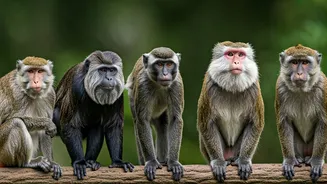

Pygmy Marmoset Marvel
The Pygmy Marmoset, celebrated as the world's smallest monkey, hails from South America. These tiny primates typically weigh between 100 to 150 grams and
measure a mere 12 to 15 centimeters in body length, excluding their tail. They live in the rainforests, primarily in the Amazon Basin. These marmosets are arboreal, spending most of their time in the trees, where they forage for food. Their diet primarily consists of tree gum, which they extract by gnawing on tree bark. They also consume insects and fruits, contributing to their diverse diet. Pygmy marmosets are known for their social behaviour, living in family groups, where they exhibit complex communication using a variety of vocalizations and scent-marking techniques. Their small size and unique foraging habits make them a compelling subject of study and conservation efforts, showcasing their significant role in their forest ecosystems.
Golden Snub-Nosed Monkeys
Native to China, the Golden Snub-nosed Monkey is known for its vibrant gold fur, a characteristic that gives it its name. This monkey species is adapted to live in temperate forests and high-altitude mountainous regions. They are medium-sized monkeys, exhibiting a distinctive snub nose and a long, slender tail. They mainly feed on a mix of leaves, fruits, seeds, and bark, adapting their diet to seasonal food availability. Golden Snub-nosed Monkeys are highly social, living in large troops that can comprise several hundred individuals. They display complex social structures and communication methods. Facing threats from habitat loss due to deforestation and human activity, coupled with hunting, this species is considered vulnerable. Conservation efforts are crucial to protect their habitat and population, ensuring the survival of this remarkable primate in its natural environment.
Bald Uakari’s Unique Appearance
Found in Brazil, the Bald Uakari, or Red-Faced Monkey, is instantly recognizable due to its bald head and vibrant red face. This striking coloration is a result of blood vessel density. Their appearance serves as a visual indicator of health. They inhabit the flooded forests and wetlands of the Amazon Basin, adapting to a life that involves seasonal changes in water levels. Their diet primarily comprises fruits and seeds, which play a crucial role in seed dispersal within their habitat. They are known for their social behaviour, living in troops where communication and social interaction are key. Habitat loss and hunting are major concerns for their populations, making conservation essential. Protecting their natural environment will preserve this unique primate and its contribution to the ecological balance of the Amazon.
Proboscis Monkey’s Distinctive Nose
The Proboscis Monkey, indigenous to Borneo, is recognized for its peculiar large nose. The size of the nose is particularly pronounced in adult males. They reside in the rainforests and mangrove swamps along rivers and coastlines. Their diet is primarily herbivorous, consisting mainly of leaves, fruits, and seeds. They are well-adapted for an arboreal life, using their specialized limbs and tails to navigate through the trees. These monkeys are social animals, living in troops that include multiple females and one dominant male. They are skilled swimmers, often crossing rivers and waterways. Threats to their population include habitat loss due to deforestation for palm oil plantations and logging, as well as hunting. Conservation efforts are vital to protect their forest homes and sustain the survival of these unique primates.
Roloway Monkey of West Africa
Originating in West Africa, the Roloway Monkey is characterized by its long, white beard and a distinctive white stripe on its thighs. They are medium-sized monkeys that inhabit tropical rainforests. They consume a diet of fruits, leaves, insects, and seeds. Roloway Monkeys are arboreal creatures, spending their lives primarily in the trees, where they find food and evade predators. They live in social groups, where complex interactions and communication help maintain social order. The Roloway Monkey is critically endangered, primarily due to habitat loss from deforestation and the bushmeat trade. Conservation actions are imperative to safeguarding their diminishing habitats and preventing these monkeys from facing extinction, ensuring their survival within their native environments.
Celebes Crested Macaque Wonders
The Celebes Crested Macaque, native to Indonesia, features a unique appearance marked by a prominent crest of hair atop their head. These macaques inhabit the tropical rainforests on the island of Sulawesi, thriving within diverse ecosystems. They have a varied diet, consuming fruits, seeds, insects, and invertebrates. They are adept at navigating both the forest floor and tree canopies. They live in groups, where strong social bonds and intricate behaviours help maintain group dynamics. Their populations face threats from habitat destruction due to deforestation, the encroachment of agriculture, and hunting. Conservation initiatives are crucial to protect their forest ecosystems and encourage the longevity of this distinctive primate species, ensuring its survival against mounting challenges.
Titi Monkey’s Adaptability
South America is home to the Titi Monkey, a medium-sized primate known for its varied species and adaptable behaviours. These monkeys live in a broad range of habitats, including rainforests, flooded forests, and savanna woodlands. Their diet consists of fruits, leaves, insects, and small vertebrates. They are generally arboreal creatures, skilled at navigating through trees, which are essential for both foraging and protection. They are known for their strong pair bonds, with mating pairs often staying together. Conservation efforts are required to protect their varied habitats and to fight against the effects of deforestation and the illegal pet trade. Promoting responsible forest management and community engagement can lead to the preservation of these fascinating primates and their essential contribution to their ecosystems.