





The Lunar Laboratory
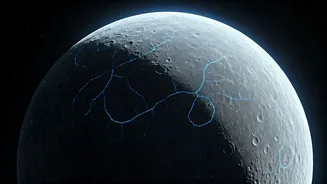
NASA's interest in the Moon extends far beyond simple exploration; it's using the Moon as a key laboratory to study Earth's most precious resource: water.
The lunar surface and its environment provide a unique setting to analyze water. Scientists believe that by examining the lunar poles, where ice may exist, they can gather clues about the origins and history of water on Earth. Missions like these aim to identify water's source, its journey to our planet, and how it has changed over billions of years. This understanding is critical for gaining insight into the processes that shaped our planet and for preparing for future space exploration, where water will be essential for life support and resource utilization. The Moon offers a pristine record, relatively untouched by the geological processes that constantly reshape Earth, making it an ideal place to learn.
Water: Earth's Origin
A core question for scientists revolves around where Earth's water initially came from. One leading theory suggests it arrived through impacts from asteroids and comets. However, the precise timing and composition remain unclear. NASA's lunar missions aim to provide evidence that could support or refute this theory by analyzing the isotopic composition of water ice found on the Moon. This ice could preserve the signatures of ancient water sources. If the isotopic ratios match those found in Earth's oceans, this would strongly support the idea that these extraterrestrial impacts were responsible for delivering a significant portion of our planet's water. Additionally, investigating the distribution of water on the Moon – its abundance, and its location – would offer valuable data on how water can be stored and transported in space. That information would directly influence the design of future exploration missions and settlement plans.
Unveiling Lunar Water
NASA's exploration strategies on the Moon are designed to identify and characterize water in various forms. This includes looking for water ice in permanently shadowed craters at the lunar poles, which are shielded from direct sunlight and could have trapped ice for billions of years. Instruments aboard lunar orbiters and rovers are employed to scan the surface and subsurface for signs of water. These instruments can detect subtle variations in the lunar surface and analyze the composition of materials. The data collected provides insights into the quantity of water, its physical state, and its location. Analyzing water samples is critical because these analyses allow scientists to compare the ice with water on Earth. With this approach, scientists can test theories about the origins of water. Moreover, detailed mapping of water resources on the Moon is not only a scientific endeavor but also a practical step towards utilizing this resource for future lunar bases and space missions. Water is essential for sustaining life, and can be broken down to produce breathable oxygen, and rocket fuel.
Implications Beyond Earth
Understanding the origins of water on Earth has profound implications beyond our planet. It provides critical insights into the formation and evolution of other planetary bodies in our solar system and beyond. Studying lunar water, and its relationship to Earth's water, helps us to understand how water, and potentially life, could be distributed throughout the cosmos. This research also contributes to the study of the habitable zones around stars and the conditions that may be conducive to life. Moreover, successful water extraction and utilization on the Moon could pave the way for sustainable long-term space exploration, allowing us to establish bases and undertake missions farther into the solar system, with a constant supply of resources, and oxygen. The discoveries made during NASA's lunar missions will greatly shape our understanding of our place in the universe.