







Early Vision, Delayed Start
The genesis of the Navi Mumbai International Airport (NMIA) can be traced back to 1986. A committee, led by J.R.D. Tata, recognized that Mumbai's sole
airport's constraints would be a problem as air traffic grew. The initial studies in 1996 examined the feasibility of an airport in Navi Mumbai. This was followed by more detailed techno-economic studies between 1999 and 2000 that supported the need for additional airport capacity, with the Panvel region emerging as a possible location. The Maharashtra government formally proposed the project to the Centre in 2001. The Ministry of Civil Aviation evaluated various sites in the Mumbai Metropolitan Region, but Navi Mumbai was considered suitable primarily for domestic operations. Later, the plan was changed to include two parallel runways.
Hurdles and Setbacks
In the initial years, the project faced considerable obstacles. In April 2008, the Ministry of Environment rejected approval, which led to a pause in the project, and also raised questions about location and design. Despite discussions of alternative locations, the state government insisted on proceeding with the project in Navi Mumbai. Years were spent on studies, and revised plans, which caused substantial delays. A crucial technical issue was addressed in 2006 when the International Civil Aviation Organisation (ICAO) studied whether two airports could operate safely in close proximity. The study determined that coordinated operations were indeed feasible. Land acquisition and the rehabilitation of affected families also presented considerable challenges, affecting thousands of families across several villages.
The Adani Era
A significant turning point happened in 2021 when the Adani Group took over the project in collaboration with Cidco. By then, over 35 years had elapsed since the concept of a second airport had initially been suggested. The actual construction then started. Even though international tenders were released in 2014, and a GVK-led consortium was chosen in 2017, the project continued to face on-ground delays. Before the airport neared completion, major pre-development work was finished. This included preparing the land and diverting rivers, which prepared the site for the next phase. The airport was inaugurated by Prime Minister Narendra Modi on October 8, with operations starting on December 25.
Operational Launch Phase
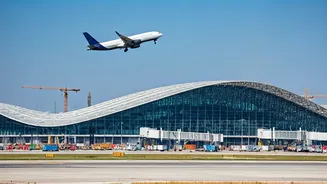
The NMIA is set to start with a restricted schedule. During its initial month, it is planned to operate for 12 hours a day from 8 am to 8 pm. It will handle roughly 23 departures daily, or about 46 flight movements, including arrivals. Airlines such as IndiGo, Akasa Air, and Air India Express will offer domestic services during this initial phase, with flight numbers expected to increase gradually. The airport will begin with Terminal 1, which has the capacity to handle up to 20 million passengers annually. A second terminal, planned for later phases, will boost capacity. The airport will eventually have two parallel runways and a separate cargo facility.
Addressing Capacity Issues
Mumbai's aviation infrastructure has evolved largely in response to mounting pressure rather than advance planning. The Juhu aerodrome was the primary airport until the Santa Cruz airport opened in 1942, initially handling just six flights a day. Each expansion, including a new terminal at Sahar in the late 1970s and the opening of a revamped and privatised Mumbai airport with an integrated terminal in 2014, provided temporary relief. As passenger traffic increased, there was reinforcement of the need for an additional airport outside the city. The fully developed airport is expected to handle up to 60 million passengers annually, thereby easing pressure on Mumbai’s existing airport. This will cater to the rising demand for air travel.
Environmental and Regulatory
The proposed airport site on the Kopra Panvel stretch is situated in an ecologically sensitive zone. Nearly one-third of the land fell within the Coastal Regulation Zone. The presence of mangroves, wetlands, and two rivers made clearances difficult, adding to the complexities and extending the timeline for approvals. The project underwent a detailed environmental impact assessment, which was submitted in December 2009, further delaying the project. Regulatory issues, along with land acquisition and the subsequent rehabilitation of displaced families, were among the key challenges that the project faced.