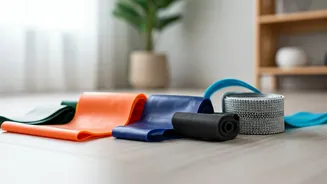

Introduction to Resistance
Resistance bands have become an essential tool for those looking to stay fit. Their portability and ease of use make them perfect for at-home workouts,
especially during winter when outdoor activities are less appealing. These bands provide a gentle yet effective way to build strength and flexibility. They come in various resistance levels, from light to heavy, suitable for all fitness levels. This guide will take you through eight top-rated bands, each with unique features and benefits to help you achieve your fitness goals.
Loop Resistance Bands
Loop resistance bands, often made of latex or fabric, are a popular choice. They are versatile and can be used for a wide range of exercises. These bands are great for lower body workouts, such as squats, glute bridges, and lateral walks. They’re excellent for beginners because you can adjust the resistance simply by changing the band's size or using multiple bands. When choosing loop bands, consider the different resistance levels and the material's durability. They are compact and easy to store, making them a travel-friendly option for staying active on the go.
Tube Resistance Bands
Tube resistance bands, equipped with handles, offer more exercise options. These bands are attached to handles, giving you better grip and allowing you to perform exercises that target various muscle groups. Tube bands are ideal for upper body exercises such as bicep curls, tricep extensions, and shoulder presses. They often come with a door anchor, expanding your workout possibilities by allowing you to attach them to a door. Look for bands with sturdy handles and strong attachments to ensure safety and longevity. Tube bands provide versatility and are suitable for more advanced exercises.
Figure-8 Resistance Bands
Figure-8 resistance bands are perfect for targeted exercises focused on arms and shoulders. These bands feature a figure-8 shape with handles, making them ideal for shoulder rotations, bicep curls, and tricep extensions. They are typically available in various resistance levels and are known for their simplicity and ease of use. Figure-8 bands allow for a full range of motion, providing a good workout in a compact package. They are great for quick workouts and for those who want to focus on isolating specific muscles.
Therapy Resistance Bands
Therapy resistance bands, often sold in long, flat strips, are excellent for rehabilitation and stretching exercises. These bands are usually color-coded to indicate different resistance levels. They are versatile for many exercises such as stretching, and targeted muscle activation. The flat design allows for easy gripping and wrapping around limbs for various exercises. The bands provide gentle resistance and can be used by people of all fitness levels. Therapy bands are a valuable addition to any home workout regimen.
Mini Resistance Bands
Mini resistance bands, also called booty bands, are small loop bands primarily used for lower body workouts. These bands are excellent for activating glutes, hamstrings, and hip muscles. They are often placed around the thighs or ankles during exercises like squats, side steps, and hip thrusts. Mini bands increase the difficulty of exercises and help improve muscle engagement. They are made of fabric or rubber and come in varying resistance levels. These bands are portable and are great for travel.
Choosing the Right Bands
Choosing the right resistance bands depends on your fitness goals and current fitness level. Beginners should start with lighter resistance bands and gradually increase as they get stronger. It's important to consider the materials, the handle type, and the resistance levels. For a full-body workout, you might want a set of different bands, including loop bands, tube bands, and mini bands. Read reviews and consider brands known for quality and durability. Proper maintenance, such as avoiding extreme temperatures and inspecting bands for wear and tear, can extend the lifespan of your bands.
Home Workout Routines
Incorporating resistance bands into your home workout is easy. You can create a full-body workout by including a mix of exercises. For example, use loop bands for squats, mini bands for glute bridges, tube bands for bicep curls, and therapy bands for stretching. Aim for multiple sets of each exercise, with 10-15 repetitions. Warm up with light cardio and stretching before your workout. Cool down with stretching at the end. Consider mixing the bands in your workout for variety and to target different muscle groups. Consistency is key for achieving results. Regularly working with resistance bands will lead to noticeable improvements in strength, flexibility, and overall fitness.