




Defining Black Holes
Black holes, often described as cosmic giants and gravity traps, are regions in spacetime where gravity is so intense that nothing, not even light, can
escape. These extraordinary objects are formed from the remnants of massive stars that have collapsed under their own gravity. The boundary of a black hole, known as the event horizon, marks the point of no return. Any object or radiation that crosses this boundary is inevitably drawn in. Black holes are not 'holes' in the traditional sense; they are three-dimensional regions of space that have an incredibly concentrated mass. Their existence was predicted by Albert Einstein's theory of general relativity, and they have been confirmed through various observations and experiments. These phenomena defy the conventional laws of physics, making them both fascinating and perplexing to scientists.
Types of Giants
Black holes come in various sizes and types, each with unique characteristics and origins. Stellar black holes are formed from the collapse of massive stars, typically with masses ranging from a few times to dozens of times that of our sun. These are relatively common throughout the universe, and their existence has been well-documented. Supermassive black holes, on the other hand, reside at the centers of most galaxies, including our Milky Way. These behemoths can have masses millions or even billions of times greater than the sun. Their formation is not fully understood, but it is believed they grow by accreting matter from their surroundings, including gas, dust, and even stars. Intermediate-mass black holes, with masses between stellar and supermassive black holes, are rarer and their existence is still being actively investigated. These can be found in globular clusters or dwarf galaxies.
Formation Explained
The formation of black holes is a fascinating process closely linked to stellar evolution. Stellar black holes are created when massive stars exhaust their nuclear fuel and collapse. Once a star's core runs out of fuel, it can no longer generate the outward pressure needed to counteract the inward pull of gravity. As the core collapses, it triggers a supernova explosion, which expels the star's outer layers. If the remaining core is massive enough, it continues to collapse, forming a singularity—a point of infinite density. Supermassive black holes at the centers of galaxies are thought to form through various mechanisms, including the merging of smaller black holes, the accretion of vast amounts of gas and dust, and the direct collapse of massive gas clouds. The growth of these massive objects continues over billions of years as they consume surrounding matter. The precise details of how these supermassive objects take shape remain areas of active research.
Gravity's Influence
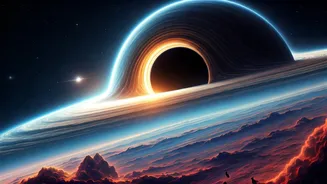
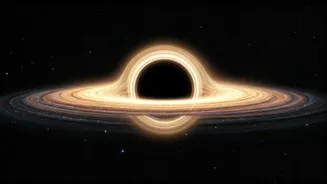
Black holes are characterized by their intense gravitational pull, a consequence of the concentration of mass within a small space. This gravity affects everything around them, bending light, distorting space and time, and even tearing apart objects that get too close. The event horizon marks the boundary beyond which nothing can escape the gravitational grasp of a black hole. When matter falls into a black hole, it spirals inward, forming an accretion disk—a swirling disc of gas and dust that heats up and emits powerful radiation. This radiation can be observed by astronomers, providing valuable clues about the presence and behavior of black holes. The extreme gravity of black holes also causes time dilation, meaning that time slows down for objects near the event horizon relative to observers farther away. This phenomenon is a direct consequence of Einstein's theory of general relativity, and it further demonstrates the profound impact of black holes on spacetime.
Observing Black Holes
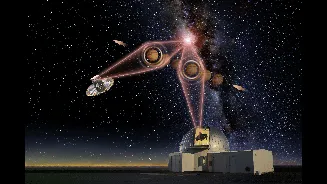
Despite their invisibility, black holes can be detected through their gravitational effects on surrounding matter and space. When a black hole interacts with a star or gas cloud, it can cause the material to be pulled inward, forming an accretion disk that emits intense X-rays and other forms of radiation. Astronomers can observe these emissions using telescopes and other instruments. Gravitational lensing, the bending of light around a massive object, provides another means of detecting black holes. As light from a distant object passes near a black hole, its path is bent, creating distorted images or multiple images of the background object. The Event Horizon Telescope, a global network of radio telescopes, captured the first direct image of a black hole in the galaxy M87, confirming decades of theoretical predictions. This breakthrough provided concrete visual proof of these enigmatic objects, revolutionizing our understanding of them. Ongoing research continues to refine our knowledge of their properties and their role in the cosmos.