





Dravidian Politics' Deep Roots
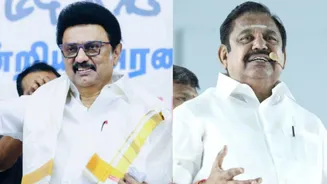
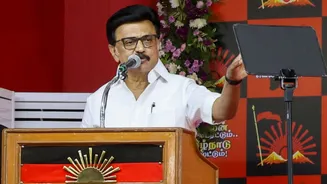
Tamil Nadu's political narrative has been largely shaped by the Dravidian movement since 1967, with the DMK and AIADMK alternating power. The DMK, founded
by C.N. Annadurai, championed social justice, secularism, and Tamil pride, offering a powerful counter to national parties. Its offshoot, the AIADMK, was established by the charismatic actor M.G. Ramachandran after a significant split, building upon a similar ideology of welfare, development, and cultural resonance. This long-standing duopoly has historically left limited space for external political forces to gain substantial ground, creating a deeply entrenched political landscape defined by these two major Dravidian parties and their appeals to regional identity and popular sentiment.
Vijay's TVK Emerges
In a significant political shift, the renowned actor Vijay launched his party, Tamilaga Vettri Kazhagam (TVK), in 2024. This move directly challenges the established DMK and AIADMK, aiming to tap into a widespread sentiment against corruption and dynastic politics that has become prevalent in the state. TVK positions itself as a fresh alternative, seeking to carve out its own space by critiquing the existing power structures. While referencing key figures like Periyar and Ambedkar, Vijay's party emphasizes inclusive power-sharing and aims to redefine Tamil cultural discourse, moving beyond the traditional narratives propagated by the dominant Dravidian parties.
MGR's Blueprint and Vijay's Echoes
The political entry of M.G. Ramachandran in 1972 with the AIADMK offers a compelling historical parallel to Vijay's current ambitions. MGR's party wasn't just a reaction; it was built on 'Annaism,' a framework emphasizing social justice, secularism, and state autonomy, while fostering Tamil pride and inclusivity. This ideological foundation, coupled with his immense stardom, propelled the AIADMK to power in 1977 amidst a fragmented political landscape and anti-incumbency sentiment, securing a significant vote share and a majority of seats. Vijay's strategy appears to echo this playbook by leveraging his vast fanbase, particularly among the youth, and capitalizing on prevailing fatigue with existing welfare schemes and reported scandals, aiming to disrupt the established political order through charisma and a new ideological appeal.
Current Political Landscape & Future Prospects
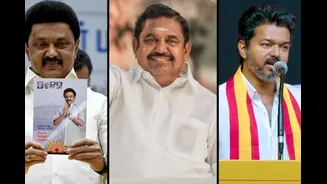
With upcoming elections, Tamil Nadu is witnessing a vibrant three-way contest involving the DMK, AIADMK, and Vijay's TVK. While pre-poll surveys suggest the DMK alliances are projected to command a significant 40-45% vote share, potentially securing 150-189 seats, TVK is estimated to garner between 9-15% of the vote, translating to a projected 6-50 seats. This indicates a substantial, though not dominant, initial impact. Both MGR and Vijay demonstrate the power of charismatic leadership to challenge established political duopolies, often by subtly adjusting ideologies and capitalizing on opportune timing. While Vijay's formidable fanbase and anti-establishment platform present a potent force, the legacy of MGR's political success remains a high bar to reach, suggesting that while he could be a transformative figure, achieving such a towering status is a long-term aspiration.