
Initial Currency Shift
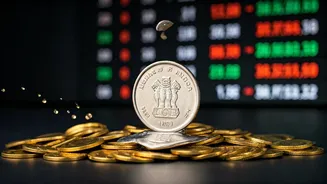
In July 2022, the Indian Rupee (INR) crossed the 80-per-dollar mark, prompting questions about the factors behind this change. The article aims to uncover
the driving forces that led to the rupee's depreciation over the preceding three-and-a-half years or so. HSBC India's Pranjul Bhandari pointed out that the rupee's weakening and elevated tariffs were key aspects. This article seeks to understand these influences and their implications for the Indian economy.
Weakening Rupee's Role
One significant point raised is the idea that a gradually weakening rupee acts as a beneficial shock absorber, especially in the context of high tariffs. According to Bhandari, this depreciation is a suitable response to the problem of elevated tariffs. The concept behind this is that a weaker rupee can make Indian exports more competitive in the global market, thereby offsetting the negative effects of high tariffs. This implies that the government might welcome a moderate depreciation of the currency to boost exports and protect domestic industries.
Inflationary Impact
The discussion then considers the impact of a weakening rupee on inflation, particularly imported inflation, which is a common concern. However, given that inflation was almost zero at the time the article was written, the situation was viewed as potentially favorable for rupee depreciation. This is because, under low inflation conditions, the negative effects of a weaker currency, such as higher import prices, are minimized. Therefore, the depreciation could be more easily absorbed by the economy without triggering significant inflationary pressures, presenting an opportune moment for the rupee to depreciate.
Trade Deal Upsides
The article further considers whether a trade agreement with the United States could serve as a trigger for rupee appreciation and what sort of upside such a deal might provide. A trade deal could boost investor confidence, leading to capital inflows and strengthening the rupee. The specifics of the potential upside, like the extent of rupee appreciation, would depend on the size and scope of the trade agreement, as well as the overall global economic situation. This emphasizes the importance of international trade relations in determining the currency's value.
Economic Growth Aspects
The weakening currency also brings the prospect of increased exports and consequently, GDP growth. However, the analysis also notes potential downside risks. While a weaker rupee makes exports cheaper, it also increases the cost of imports. This could lead to a trade-off, potentially affecting sectors dependent on imported goods or raw materials. The economic impact requires careful evaluation, considering both positive and negative consequences. Policymakers must weigh these factors to make decisions that best serve the country's economic interests, understanding the complex interplay of currency valuation, trade, and overall economic performance.
RBI's Leadership
The article also touches on the potential impact of changes in leadership at the Reserve Bank of India (RBI). It suggests that the exchange rate might have moved more freely under Governor Sanjay Malhotra. This hints at the RBI's policies and how they can influence the value of the rupee. The discussion implies that the RBI's approach to managing the currency may have evolved, which impacted the currency's behavior. The shift in leadership and the consequent policy changes highlight the central bank's influence on the exchange rate.