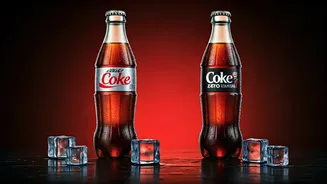






Flavour: The Core Distinction
The most significant divergence between Diet Coke and Coke Zero Sugar lies in their taste. Coca-Cola itself clarifies that while both beverages offer a sugar-free
and calorie-free experience, their flavour compositions differ substantially. Coke Zero Sugar is engineered to closely mimic the taste of the original Coca-Cola, often referred to as 'Original Taste' or 'Red Label' Coke. In contrast, Diet Coke possesses its own unique flavour blend, which many describe as lighter and distinct from the classic Coke profile. This difference is so pronounced that enthusiasts often express a preference for one over the other, with some actively seeking the characteristic taste of Diet Coke rather than an approximation of the original, as highlighted by anecdotal evidence from online forums. The intention behind Coke Zero Sugar was specifically to cater to those desiring the familiar Coca-Cola flavour without the sugar content, differentiating it from Diet Coke's established, unique identity.
A Tale of Two Launches
The history of these two popular sugar-free colas reveals strategic decisions and evolving consumer preferences. Diet Coke was a pioneering beverage, introduced by Coca-Cola in 1983 as their very first sugar-free cola option. Its creation was marked by a deliberate effort to craft a formula entirely separate from the flagship Coca-Cola. This was driven by a concern among executives that a diet version might cannibalize sales of the original product. The success of Diet Coke was substantial, to the extent that when Coca-Cola experimented with 'New Coke' in 1985, the formula for that now-infamous beverage was actually based on the Diet Coke recipe. Fast forward to 2005, Coke Zero was introduced with a different objective: to provide the taste of classic Coca-Cola without the sugar. This product was later updated and rebranded as Coca-Cola Zero Sugar in 2016, signifying a refinement of its formulation and marketing to further align it with the original Coca-Cola taste profile. This timeline underscores the distinct paths and market positions each beverage was designed to occupy from their inception.