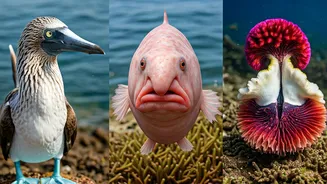







The Foolish Booby Bird
The aptly named Booby Bird, scientifically known as Sula, hails from tropical seas and earns its moniker from the Spanish word 'bobo,' meaning foolish.
This name stems from early mariners' observations of the birds appearing rather clumsy on land. However, these initial impressions belie their true prowess; Booby Birds are exceptionally skilled divers, capable of plunging at remarkable speeds to snatch their prey from the ocean's depths. A distinctive feature, especially in the Blue-footed Booby subspecies, is their vividly colored feet, adding to their unique visual appeal. Their terrestrial awkwardness is a stark contrast to their aerial and aquatic grace. These birds are a testament to how appearances can be deceiving, with their seemingly ungainly movements on land masking incredible diving abilities crucial for survival. The vibrant blue of their feet is not just for show; it plays a role in courtship rituals, further highlighting the complexity of these creatures beyond their humorous appellation.
Alarmed Dik-dik Antelope
The Dik-dik, a genus of tiny antelopes known as Madoqua, inhabits the savannas and woodlands of eastern and southern Africa. Its distinctive name originates from the sharp, high-pitched alarm call it emits when sensing danger, a sound reminiscent of 'dik-dik.' These miniature ungulates stand at a mere 30 to 40 centimeters tall, positioning them among the smallest antelope species. Despite their diminutive stature, Dik-diks are remarkably swift and agile, adept at navigating dense undergrowth to evade predators. Their small size and speed are their primary defense mechanisms in a challenging environment. These creatures are masters of camouflage and quick escape. Their ability to make such a specific, name-generating vocalization is a fascinating adaptation. They rely heavily on their keen senses and their ability to disappear into thick vegetation to survive the constant threat of predation from various carnivores native to their African habitats.
Deep-Sea Bony-eared Assfish
The Bony-eared Assfish, scientifically classified as Acanthonus armatus, is a denizen of the Atlantic Ocean's abyssal plains, thriving in an environment characterized by immense pressure and perpetual darkness. Its peculiar name is not derived from any behavioral trait but rather from specific anatomical features of its skeleton and its taxonomic grouping within deep-sea fish families. This species is a prime example of life's remarkable adaptability, flourishing in one of the planet's most extreme and inhospitable ecosystems. The adaptations required to survive at such depths are profound, affecting everything from physiology to sensory perception. These fish are built to withstand crushing pressures that would obliterate most surface-dwelling organisms. Their skeletal structure, from which the 'bony-eared' part of its name likely originates, is adapted to these conditions. The 'assfish' component of its name, while sounding peculiar, is a taxonomic descriptor that may relate to its overall shape or relationship to other fish species. Its survival in such an environment highlights the diversity of life and the evolutionary strategies developed to colonize even the most challenging niches on Earth.
Vibrant Sparklemuffin Spider
The Sparklemuffin Spider, formally known as Maratus jactatus, is an Australian native that lives up to its dazzling moniker. This species belongs to the peacock spider family, renowned for the males' spectacular courtship displays. These tiny arachnids are characterized by their brilliant coloration and intricate mating rituals, where the males perform vibrant visual dances to attract females. The name 'Sparklemuffin' perfectly encapsulates its shimmering appearance and its lively, almost playful, engagement in attracting a mate. These spiders are not just visually stunning; their behavior is equally captivating. The males' elaborate displays involve complex movements and the flashing of brightly colored abdominal flaps, a form of visual communication unique to their species. The discovery and naming of such a creature underscore the incredible biodiversity yet to be fully uncovered, especially in regions like Australia, and the creativity scientists employ in describing the natural world.
The Dickcissel Songbird
The Dickcissel (Spiza americana) is a small passerine bird commonly found across North and Central America, particularly in open grasslands and agricultural landscapes. Its name is a direct onomatopoeic representation of its characteristic song, which sounds like a repeated "dick-dick-ciss-ciss." During the breeding season, the male Dickcissel is known for its conspicuous perching behavior, often singing loudly from elevated spots to establish its territory and attract potential mates. This territorial singing is crucial for reproduction and species propagation. This bird's unique vocalization is not just a random sound; it serves a vital biological function. The clarity and repetition of its call make it easily identifiable to other Dickcissels. Its preference for open habitats also makes it vulnerable to habitat changes, yet its adaptability allows it to persist in areas with mixed land use. The Dickcissel is a charming example of how animal sounds can lead to memorable and descriptive names in the natural world.
Resplendent Cock-of-the-rock
The Cock-of-the-rock, belonging to the genus Rupicola, is a truly striking bird species native to the tropical forests of South America. The males are particularly renowned for their incredibly vibrant plumage, often displaying brilliant shades of orange or red, and their elaborate mating rituals. These birds gather in specific areas known as leks, where males perform energetic and visually dramatic dances to impress females. The name 'Cock-of-the-rock' aptly reflects its flamboyant appearance and its penchant for nesting and displaying in rocky outcrops and forested environments. These birds are a highlight for birdwatchers and naturalists, their appearance almost otherworldly. The males' dedication to their lekking behavior is a significant evolutionary investment, ensuring the continuation of their lineage. Their habitat preference, often near waterfalls and ravines, adds to their mystique. The intense competition and display at the leks are a crucial part of their social structure and reproductive success, making them a fascinating study in avian behavior.
The Spiny Lumpsucker
The Spiny Lumpsucker, scientifically known as Eumicrotremus orbis, is a small, globose fish inhabiting the cold waters of the northern Pacific and Atlantic Oceans. Its body is covered in a dense array of small spines, giving it a distinctly textured appearance, which contributes to its somewhat whimsical name. Despite its peculiar look and name, this species is exceptionally well-adapted to its challenging marine environment. A unique adaptation is the presence of a specialized suction disc on its underside, which it uses to firmly attach itself to rocks and other surfaces, thereby resisting strong ocean currents. These fascinating fish are masters of their environment, using their suction power to anchor themselves against powerful tidal forces that would easily dislodge less equipped marine life. Their spiny exterior may serve as a deterrent to predators, adding another layer of defense. The Spiny Lumpsucker is a testament to the diverse and often unusual forms that life takes in the ocean's cold regions, showcasing evolutionary ingenuity in the face of harsh conditions.
The Humorous Aha ha Wasp
The Aha ha is a species of wasp discovered in Australia, and yes, its scientific name is indeed 'Aha ha.' This unusual nomenclature was chosen by the entomologist who discovered it, finding humor in the classification process. Beyond its amusing name, the Aha ha wasp plays a significant role in its ecosystem as a parasitoid. This means it lays its eggs within or on other insects, effectively controlling populations of its host species. Such wasps are vital components of natural pest management within their habitats. This discovery highlights the subjective and sometimes lighthearted nature of scientific naming. While the name might evoke laughter, the wasp's ecological function is serious. By parasitizing other insects, the Aha ha contributes to the balance of its environment, preventing any single insect population from becoming overly dominant. Its existence underscores the intricate web of life and the specialized roles that even seemingly obscure species play.
The Elusive Slippery Dick
The Slippery Dick, scientifically designated as Halichoeres bivittatus, is a species of wrasse fish commonly found in the warm waters of the Atlantic Ocean and the Caribbean Sea. Its common name accurately describes its remarkable ability to quickly evade predators and fishermen's nets, wriggling free with impressive agility. These fish are known for their vibrant coloration and their swift, darting movements through coral reef environments. Despite its rather informal and perhaps suggestive name, the Slippery Dick is an integral and valuable part of the reef ecosystem, contributing to its overall health and biodiversity. Their quick reflexes and streamlined bodies are key adaptations for survival in predator-rich waters. They are an important part of the food chain and help maintain the balance within the complex coral reef habitats they inhabit. The name, while perhaps intended to be humorous or descriptive of its escape artistry, belies the ecological importance of this colorful and energetic marine species. Their presence signifies a healthy reef system.