






The AI Engine Room
As India accelerates its adoption of generative AI, the unsung heroes are the data centers – colossal structures housing immense computing power. Imagine
walking into a sprawling 20-acre data center park, where towering server racks hum with activity, performing billions of calculations to deliver the AI-driven responses we’ve come to expect. Whether it's a student seeking clarity on complex economics, a programmer debugging code, or a professional drafting an email, the seamless experience is powered by these sophisticated facilities. These are not just buildings; they are the physical foundations of the virtual world of artificial intelligence, representing a monumental infrastructure undertaking that could reshape global technological development. While the US and China lead in data center capacity, India is rapidly investing to bridge this gap, aiming to become a significant player in the AI revolution through domestic infrastructure development and data localization initiatives. Companies, both global and Indian, are pouring investments into creating these vital computing hubs across the nation, understanding that data is the new currency and data centers are its essential refineries.
Fortress of Computation
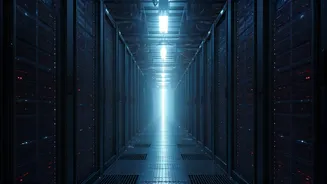
Gaining entry into these advanced data centers is a rigorous process, often involving multiple security checkpoints and the surrender of personal devices, reflecting the sensitive nature of the operations within. High-tech surveillance and dedicated security personnel maintain a watchful presence around the perimeter. Once inside, specialized lifts designed to transport large equipment ascend to climate-controlled environments. Visitors must adhere to strict protocols, stepping onto adhesive mats to eliminate dust before entering core computing areas. Access is limited to essential personnel like engineers, operations teams, and support staff, with movement tightly regulated. The interior is a spectacle of ordered technology: rows of server racks stretch towards the ceiling, adorned with blinking lights and accompanied by a constant, low hum. This is the tangible infrastructure that fuels the everyday AI applications we interact with, a testament to the complex computations happening at breakneck speed to fulfill user requests worldwide.
The Five-Layer AI Cake
The architecture supporting AI can be conceptualized as a five-layer cake. At its base lies the physical infrastructure: the land, robust electricity supply, and sophisticated cooling systems that enable data centers to function. The second layer is compute power, predominantly provided by Graphics Processing Units (GPUs). These specialized chips are indispensable for the intensive calculations required to train and operate AI models. The third layer is data itself – the vast repositories of text, images, and signals used to train AI systems. Building upon this data is the fourth layer: foundation models, which are large AI systems capable of interpreting language, images, and code. Finally, the topmost layer comprises applications, where AI is integrated into consumer and enterprise products. This layered approach highlights how GPUs are central to AI's capabilities, processing enormous datasets to identify patterns and relationships, enabling AI to learn and then respond to user queries in real-time. Consequently, every interaction with an AI system triggers a flurry of activity within data centers, powered by these high-speed GPUs.
Cooling and Power Prowess
The intense processing carried out by GPUs in AI data centers generates significant heat, necessitating advanced cooling mechanisms. These facilities employ a strategic layout of alternating hot and cold aisles. In the cold aisles, where the fronts of server racks face each other, intricate water pipelines beneath the raised floor actively circulate chilled air to dissipate heat. Behind the mesh doors of locked racks, thousands of blinking lights and dense fiber-optic cables represent immense computing power. The back of these racks emits a palpable wave of heat. To ensure continuous operation, data centers are connected to multiple external power grids, often supplemented by their own substations capable of powering the facility for extended periods in case of external grid failure. This robust power infrastructure is crucial, as even brief outages can disrupt critical AI operations. Furthermore, the high demand for electricity means that data centers are becoming significant energy consumers, prompting discussions about sustainable power sources and energy efficiency.
Evolution of Data Centers
Data centers have evolved considerably from their initial purpose. Older facilities were primarily designed as digital storage and information management hubs. In contrast, modern AI data centers are specifically engineered to handle the complex demands of training and running sophisticated AI models. While traditional data centers relied on Central Processing Units (CPUs), which process tasks sequentially, AI data centers leverage GPUs. GPUs excel at parallel processing, enabling them to handle numerous computations simultaneously, which is vital for AI workloads. This shift to GPUs brings increased power but also heightened challenges, including greater heat generation requiring more sophisticated cooling, the need for stronger racks to support heavier equipment, and a significantly larger electricity footprint. The design and operational requirements for AI data centers are thus fundamentally different, focusing on high-performance computing and parallel processing capabilities.
India's Data Center Push
India's commitment to developing its AI capabilities is strongly linked to its strategic focus on building domestic data center infrastructure. Recognizing the need for self-sufficiency, the government is actively encouraging investment through various incentives, including favorable power tariffs and land acquisition policies, alongside streamlined approval processes. Major cities like Mumbai and Chennai currently lead in data center capacity due to their strategic locations as key landing points for international submarine cables, which handle a significant portion of global internet traffic entering the country. However, this rapid expansion raises important questions regarding its environmental impact, particularly concerning the substantial electricity and water consumption of these facilities, and the actual job creation potential versus resource expenditure. As AI continues to advance, the demand for computational power is expected to surge, making the development of robust and sustainable data center infrastructure a national priority for India.
Environmental and Societal Concerns
The burgeoning growth of data centers in India presents significant environmental and societal challenges. These facilities are substantial consumers of electricity, with demand projected to more than triple by 2030, potentially increasing reliance on fossil fuels. This surge in energy consumption has already prompted extensions for coal power plants in some urban areas. Water scarcity is another critical concern, as a single megawatt data center can require millions of liters of water annually, a significant burden for water-stressed cities. While companies are exploring renewable energy sources and water recycling, the scale of demand raises questions about long-term sustainability. Furthermore, the economic benefits, particularly in terms of job creation, are being scrutinized, with some arguing that the number of jobs generated post-construction is minimal compared to the resources invested. The acquisition of land for these projects has also led to displacement and grievances among local communities, highlighting the need for equitable development and transparent community engagement.
The Future is Digital
Despite the considerable challenges, the trajectory towards an AI-driven future necessitates investment in digital infrastructure, including data centers. Experts emphasize that just as countries invest in physical infrastructure like roads and power plants, robust digital infrastructure is now indispensable. Every facet of government, business, and citizen activity is becoming increasingly reliant on AI, making the availability of adequate computing power a prerequisite for progress. If India fails to build this foundational infrastructure domestically, it risks becoming dependent on external capabilities. However, alternative perspectives suggest that this intense focus on hyperscale data centers might inadvertently lead to a consolidation of power among a few large technology companies, creating new forms of dependency. The ongoing development of data centers represents a critical juncture, balancing technological ambition with environmental responsibility and equitable societal impact.