




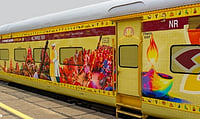

Amritsar to Attari
Embark on a brief yet historically rich 25-kilometer train expedition from Amritsar to Attari, a journey that unfolds in approximately 40-45 minutes and
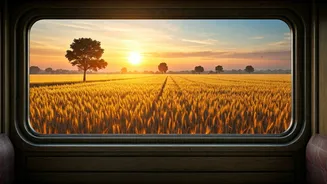
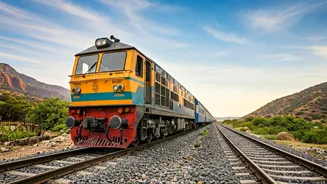
costs a mere ₹10. This route, which includes stops at Chheharta and Khasa, culminates at Attari, a station strategically positioned near the international border with Pakistan. Before the subcontinent's division, this very track seamlessly connected Amritsar with Lahore, a city now just a short distance further along the same path if borders permitted. As the train glides through the landscape, you'll witness vast expanses of verdant fields and charming small villages. Keep an eye out for Border Security Force training facilities near Khasa. The Attari station itself is a testament to colonial architecture, once serving as a vital link for cross-border rail traffic. The primary allure of Attari is the world-renowned Attari–Wagah border ceremony. Complementing this, the vicinity offers sites like Sarai Amanat Khan village, Pul Kanjri constructed by Maharaja Ranjit Singh, and Sham Singh Attari Park, which houses a museum dedicated to the esteemed Sikh general. Train services typically run twice daily in each direction, with departures from Amritsar to Attari at 7:30 AM and 6:20 PM, and return journeys from Attari at 8:20 AM and 7:15 PM.
Amritsar to Dera Baba Nanak
Experience a tranquil countryside voyage from Amritsar to Dera Baba Nanak, covering a distance of about 55 kilometers and taking approximately 1 hour and 20 minutes for just ₹15. This scenic route makes several stops, including Verka, Majitha, Ramdas, Rattar Chattar, and Hardowal, before reaching the significant town of Dera Baba Nanak in the Gurdaspur district. The railway stations along this path are adorned with attractive colonial-era buildings, often enhanced by vibrant bougainvillaea. Verka station, in particular, evokes the charm of a hill station bungalow, while Hardowal provides a serene rural ambiance. Glimpses from the train windows reveal active farms, tractors working the land, and villagers engaged in their daily activities across the picturesque countryside. Dera Baba Nanak holds profound religious importance, being the place where Guru Nanak Dev Ji spent his final years. This town is situated across the Ravi River from Kartarpur in Pakistan, the location of the revered Gurdwara Darbar Sahib Kartarpur. A key attraction here is the Kartarpur Corridor, which, when operational, permits Indian Sikh pilgrims visa-free access to the shrine in Pakistan. Visitors can also explore the Darbar Sahib gurdwara, Sri Chohla Sahib, and the local marketplace. The train operates with multiple daily services from Amritsar/Verka to Dera Baba Nanak at 4:20 AM, 10:30 AM, 2:15 PM, and 5:50 PM, with return services at 6:05 AM, 12:15 PM, 4:00 PM, and 7:20 PM.
Amritsar to Khem Karan
Undertake the most extensive of the three journeys, a 77-kilometer railway route from Amritsar to Khem Karan, requiring around two hours of travel and priced at ₹20. Some services commence from Bhagtanwala station, located near Amritsar. As the train navigates through the Taran Taran district, it passes numerous small halts, offering an intimate perspective of rural Punjabi life. Khem Karan holds considerable historical weight, notably as the site of the Battle of Asal Uttar during the 1965 Indo-Pakistani War. It was here that Indian forces successfully halted a significant Pakistani armoured offensive, a victory famously marked by abandoned tanks littering the fields, earning the area the moniker "Graveyard of Tanks." Nearby the border fence, two unique spiritual sites await: Gurdwara Sahib Singh Shaheed and Sheikh Braham Dargah. Accessing these shrines necessitates passing through Border Security Force (BSF) checkpoints. Strict regulations are in place, including prohibitions on photography and the mandatory deposit of electronic devices before entering the secured zones. Daily train services run from Amritsar/Bhagtanwala to Khem Karan at 4:40 AM, 9:15 AM, 1:35 PM, and 6:10 PM, with return trips at 6:50 AM, 11:25 AM, 3:35 PM, and 8:10 PM.
Cinematic & Winter Charm
The railway line connecting Amritsar and Attari has not only witnessed historical events but has also served as a picturesque backdrop for Indian cinema. Scenes in the movie 'Bajrangi Bhaijaan' prominently featured these tracks, symbolizing the emotional ties between India and Pakistan that transcend borders. The Attari station itself provided a setting for the film 'Veer-Zaara,' a narrative centered on love spanning across the two nations, its quiet ambiance and frontier location resonating with themes of separation and remembrance. Similarly, the modest railway station at Dera Baba Nanak has graced the silver screen, most recently in 'Gustaakh Ishq,' capturing the essence of small-town Punjab and its vintage railway architecture. Traveling these routes during the winter months, particularly in December, offers a magical experience. The mornings are often shrouded in a thick fog, softening the expansive fields around Amritsar and Attari into a tapestry of muted greys and greens. This creates a serene and slowly unfolding panorama outside the train windows, featuring wide farmlands, distant hamlets, and expansive skies.
Heritage and Borderland Insights
Several railway stations along these picturesque routes retain their original colonial architectural charm, though some historic structures have unfortunately faced neglect or demolition, such as the former stations at Chheharta and Khasa on the Attari route. The surviving colonial-era buildings, particularly those found on the Dera Baba Nanak line, present a visually striking appeal and hold potential for restoration as heritage attractions. When visiting shrines close to the international border, such as those near Khem Karan, it is imperative to be aware of the stringent security protocols. Visitors must present valid identification and pass through BSF checkpoints. Crucially, all electronic devices, including mobile phones and cameras, must be surrendered to the BSF before proceeding towards the shrine areas, and photography is strictly prohibited near the border fence. These journeys collectively offer a unique travel experience in Punjab, unveiling tranquil villages, sprawling farmlands, and narratives deeply interwoven with history, all accessible via inexpensive local trains.